

It supports case intake, clinical feature structuring, subtype pattern recognition, probable cause narrowing, red-flag identification, missing information prompts, clinician review and specialist-ready case summaries while keeping diagnosis, treatment decisions and final clinical judgment with qualified clinicians.
The goal is not autonomous diagnosis. The goal is safer, faster and more consistent clinical preparation before specialist review.
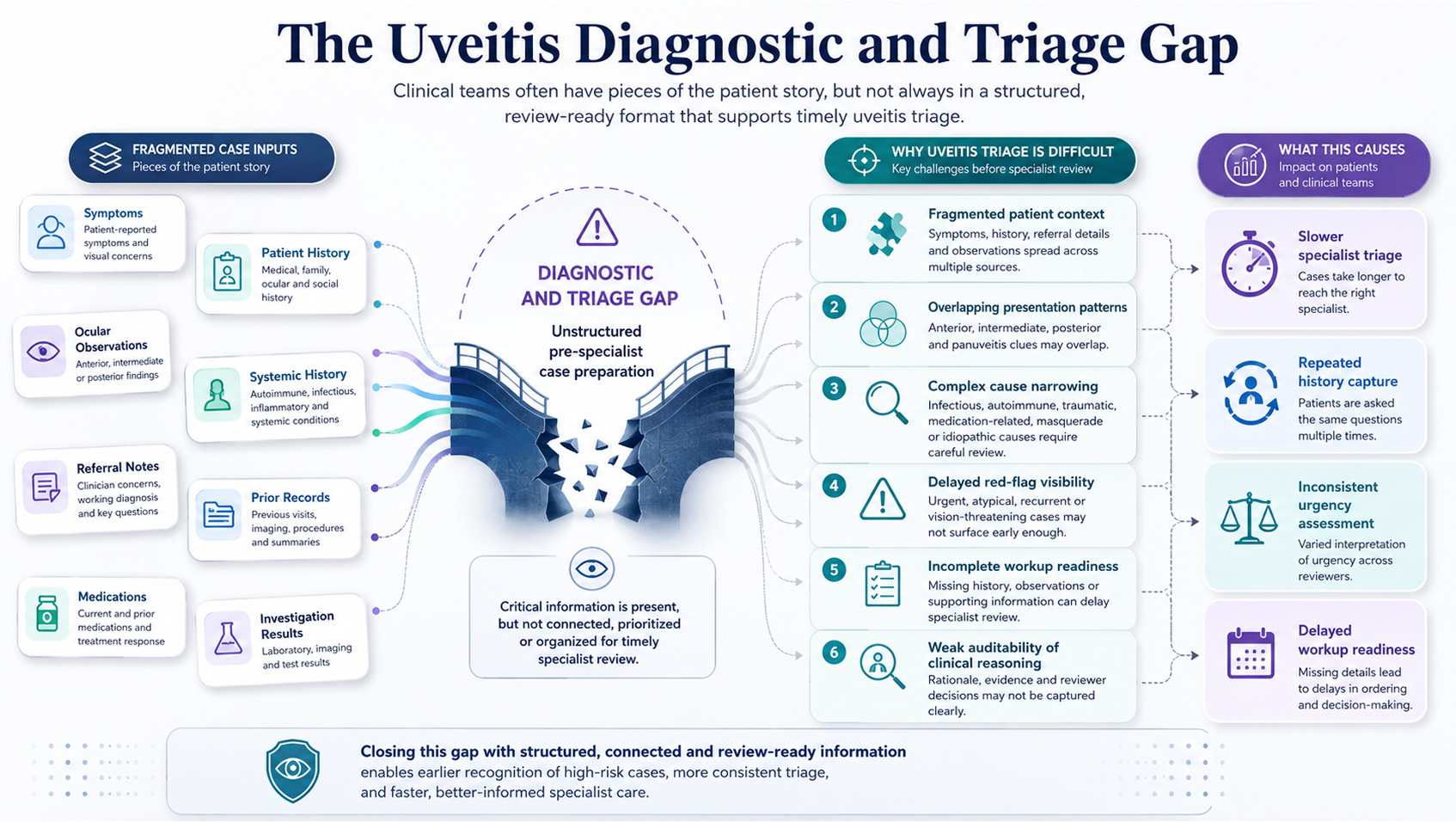
The Uveitis Diagnostic and Triage Gap
Uveitis can present with overlapping symptoms, variable severity and multiple possible underlying causes. Early triage often depends on how clearly patient symptoms, ocular findings, systemic history, prior episodes, medications and available observations are captured before specialist review.
In many care settings, this information is fragmented across referral forms, patient conversations, clinical notes, optometry observations, prior records and investigation results. As a result, clinicians may spend valuable time reconstructing the case before they can assess urgency, subtype pattern, likely cause category or next-step workup readiness.
 The Uveitis Diagnostic and Triage Gap
Key Challenges Include
Fragmented patient context
Symptoms, onset, duration, prior episodes, ocular history, systemic history, medications and referral details may be captured across multiple sources rather than one structured clinical view.
Overlapping presentation patterns
Anterior, intermediate, posterior and panuveitis presentations may share symptoms, making it important to organize anatomical involvement, laterality, onset, severity and associated clinical clues consistently.
Complex cause narrowing
Potential infectious, autoimmune, traumatic, medication-related, masquerade or idiopathic causes require careful evidence-based narrowing and clinician review.
Delayed red-flag visibility
Urgent, atypical, recurrent, bilateral, severe or vision-threatening presentations need earlier surfacing so they are not treated as routine referrals.
Incomplete workup readiness
Missing history, missing observations or incomplete supporting information can delay specialist assessment and repeated history capture.
Weak auditability of clinical reasoning
When rationale, evidence, reviewer decisions and overrides are not preserved, it becomes harder to understand why a case was triaged in a particular way.
Clinical teams often have pieces of the patient story, but not always in a structured, review-ready format that supports timely uveitis triage.
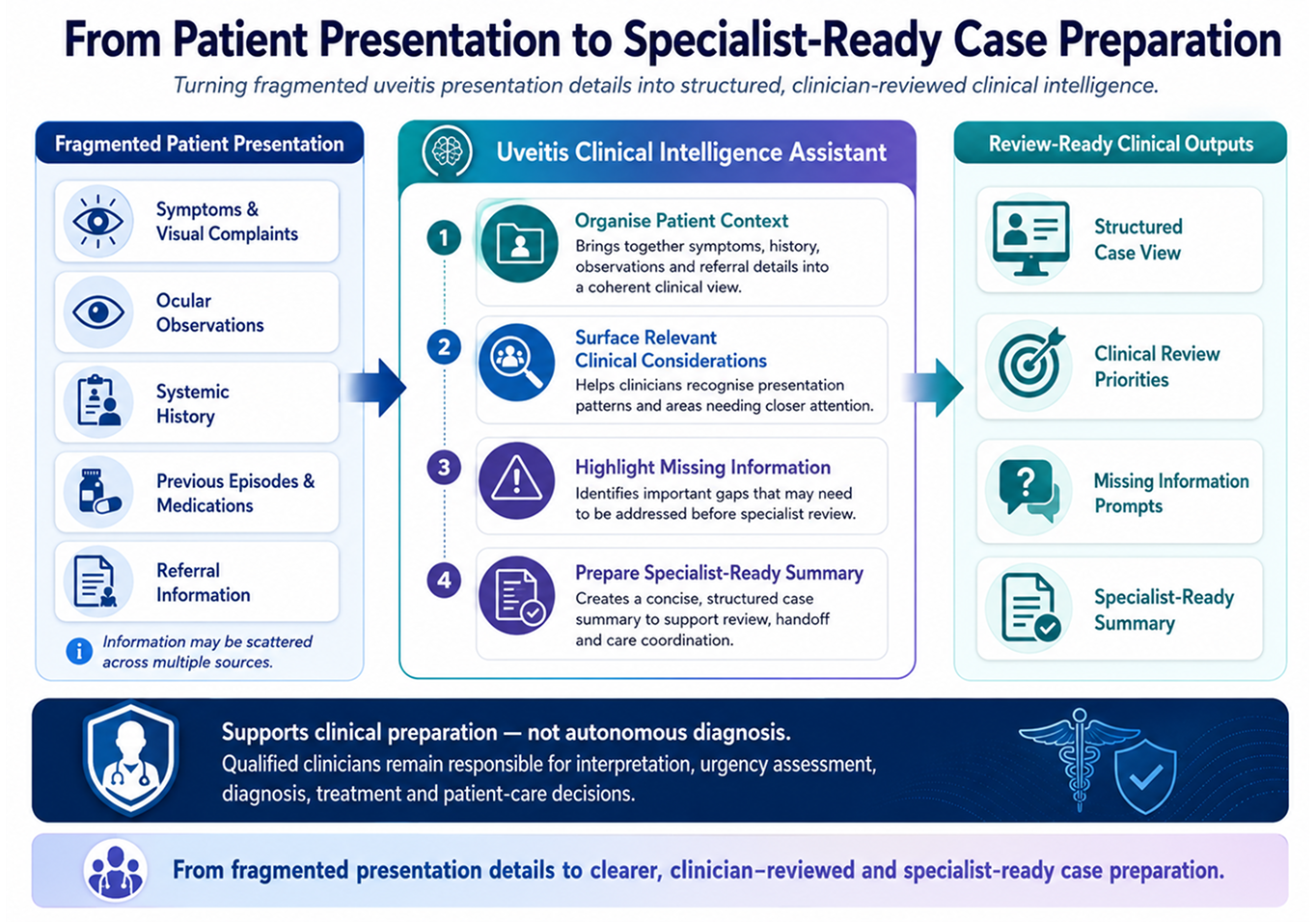
From Patient Presentation to Specialist-Ready Case Preparation
Uveitis presentations can be complex, with symptoms, ocular observations, systemic history, previous episodes, medication exposure and referral information often captured across multiple sources.
The challenge is bringing this information together in a clear and consistent format so clinicians can assess the case efficiently, recognise areas requiring closer attention and prepare for specialist review.
 From Patient Presentation to Specialist-Ready Case Preparation
Uveitis Clinical Intelligence Assistant helps convert fragmented presentation details into structured, review-ready clinical intelligence. It brings together available patient context, surfaces relevant clinical considerations, highlights information gaps and prepares a concise summary for specialist review and referral handoff.
The solution is designed to support clinical preparation—not to independently diagnose uveitis, determine treatment or replace specialist judgment. Qualified clinicians remain responsible for clinical interpretation, urgency assessment, diagnosis, treatment and all patient-care decisions.
From fragmented presentation details to clearer, clinician-reviewed and specialist-ready case preparation.
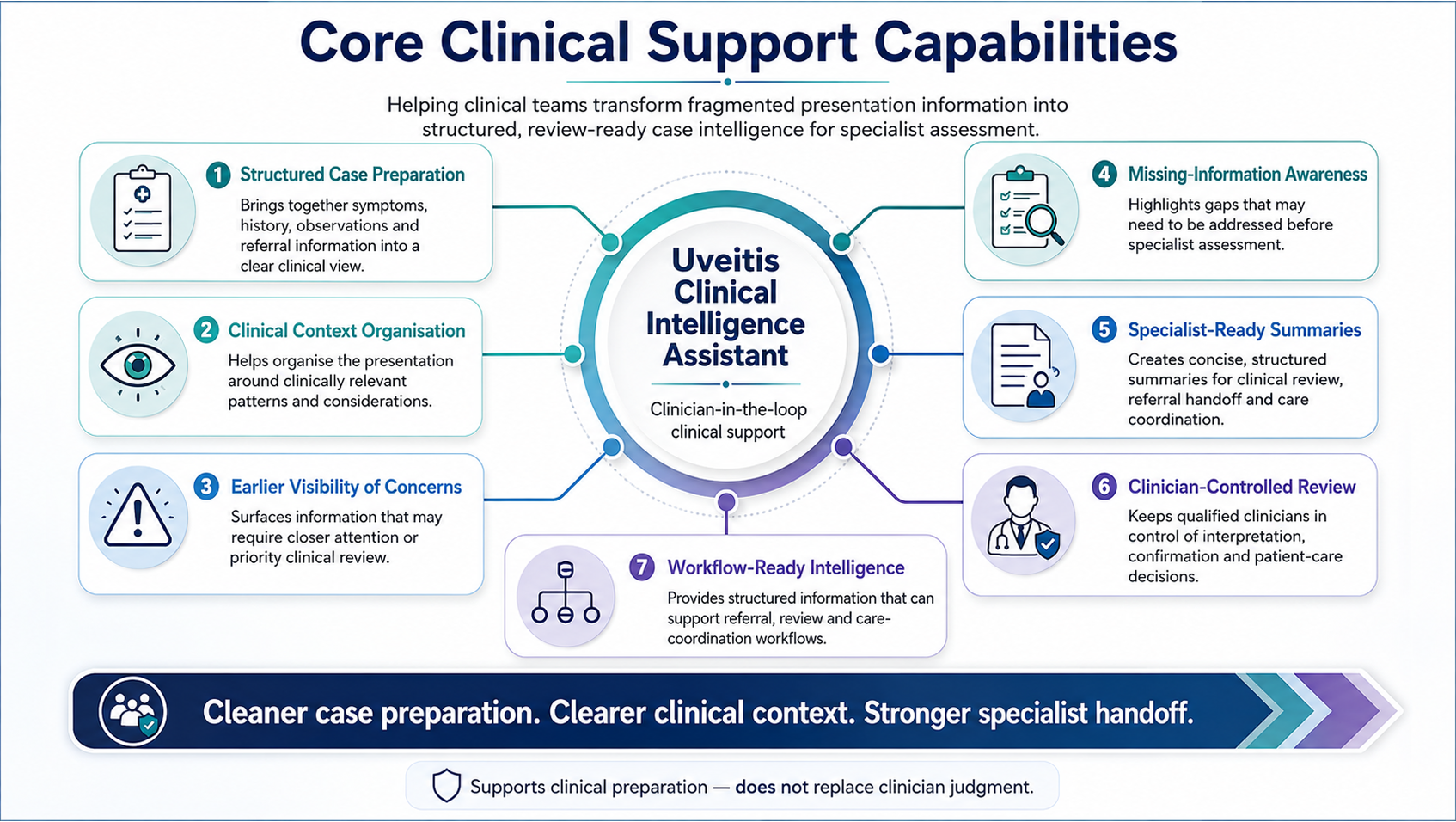
Core Clinical Support Capabilities
Uveitis Clinical Intelligence Assistant helps clinical teams transform fragmented presentation information into structured, review-ready case intelligence for specialist assessment.
It supports consistent case preparation, earlier visibility of important considerations and more efficient clinical handoff while qualified clinicians remain responsible for interpretation, urgency assessment, diagnosis and treatment.
 Core Clinical Support Capabilities
Uveitis Clinical Intelligence Assistant brings together structured case preparation, clinical-context organisation, missing-information awareness and specialist-ready summaries within a clinician-controlled workflow.
The capability can support referral, review and care-coordination processes while qualified clinicians retain responsibility for all clinical interpretation and patient-care decisions.
Cleaner case preparation, clearer clinical context and stronger specialist handoff—without replacing clinician judgment.
Designed for Diverse Clinical Care Environments
Uveitis Clinical Intelligence Assistant is designed for care environments where clearer case preparation, consistent referral information and specialist-ready clinical context can improve the quality of review and handoff.
The capability can support different care settings while adapting to established clinical workflows, information sources and governance expectations.
Ophthalmology and specialist care
Supports the preparation of structured case information before ophthalmologist or specialist review.
Referral and care networks
Helps improve the consistency and completeness of information shared across referring clinicians, specialists and care-coordination teams.
Remote and distributed care
Supports tele-ophthalmology and community eye-care pathways by organising available presentation details for clinician review.
Clinical operations and quality improvement
Provides structured, review-ready information that can support supervised workflow evaluation, service improvement and clinical coordination.
The solution is designed to strengthen existing care pathways rather than replace established clinical systems, professional judgment or patient-care responsibilities.
Consistent clinical intelligence that can support specialist review across clinics, referral networks and distributed care environments.
Measurable Value: Clinical Intelligence Quality and Workflow Impact
Uveitis Diagnostic Assistant should be measured at two levels: first, whether the SLM and agents produce reliable, structured, source-backed and review-aware clinical triage intelligence; second, whether that intelligence improves case structuring speed, triage readiness, red-flag visibility, clinician productivity and referral quality when embedded into governed workflows with clinical rules, clinician review and audit controls.
Model quality proves that the solution can interpret uveitis presentation context correctly. Workflow impact proves that this intelligence can reduce manual preparation effort, improve specialist readiness and strengthen review control without weakening clinician judgment, clinical accountability or patient-care responsibility.
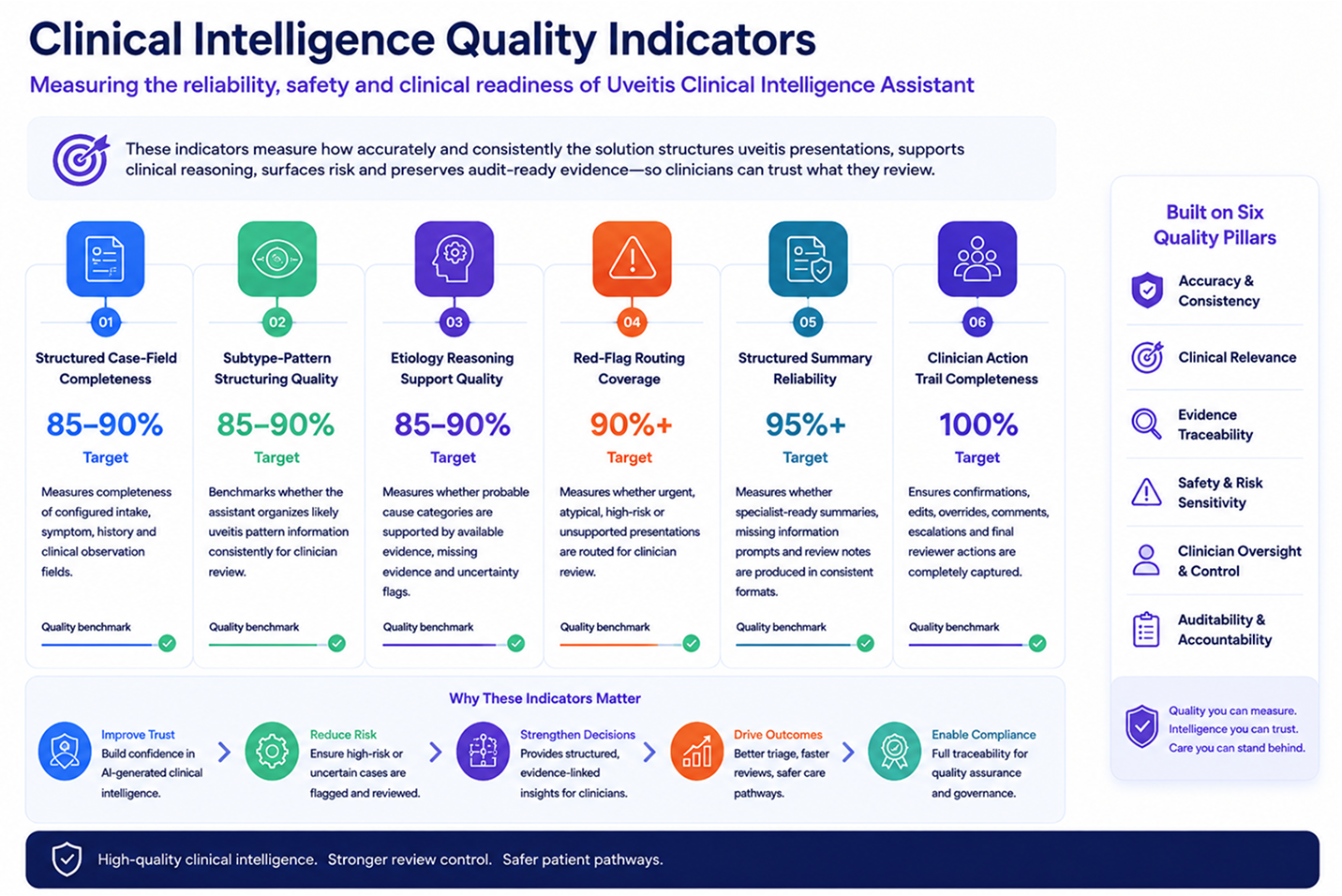
Clinical Intelligence Quality Indicators
Clinical intelligence quality indicators measure whether Uveitis Diagnostic Assistant produces triage intelligence that can be trusted in real clinical workflows. The focus is not only whether the system gives an answer, but whether it structures patient context correctly, organizes subtype clues, surfaces red flags, explains uncertainty, links outputs to source evidence and routes high-risk or unsupported cases for clinician review.
 Clinical Intelligence Quality Indicators
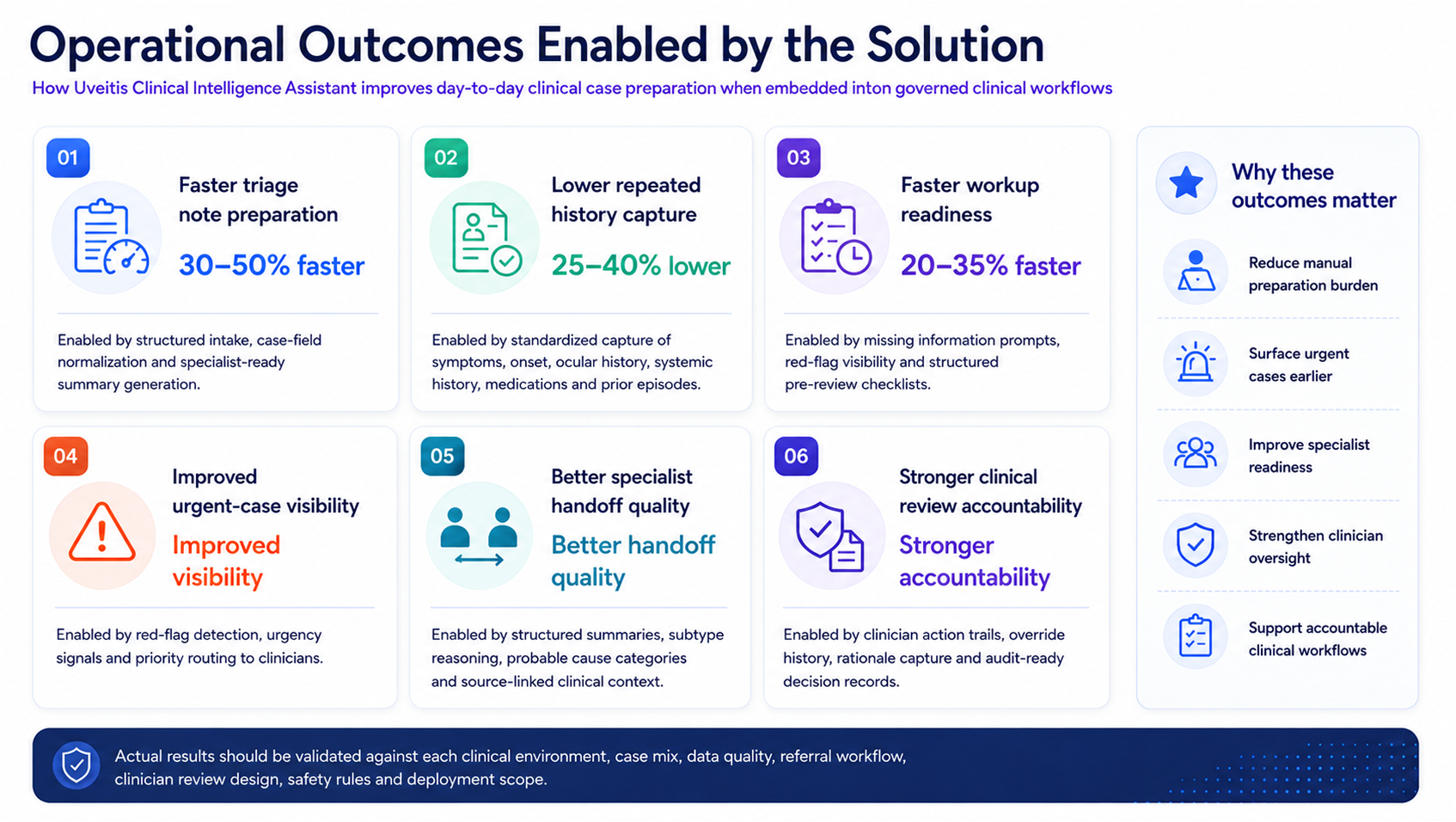
Operational Outcomes Enabled by the Solution
Operational outcomes measure how Uveitis Diagnostic Assistant improves day-to-day clinical triage preparation when its intelligence is embedded into governed clinical workflows. The focus is whether structured, source-backed and clinician-reviewed outputs help care teams prepare cases faster, reduce repeated history capture, improve workup readiness, identify urgent cases earlier and strengthen specialist handoff quality.
 Operational Outcomes Enabled by the Solution
Clinician-Governed by Design
Uveitis Clinical Intelligence Assistant is designed for clinical environments where patient safety, professional accountability and human oversight are essential.
It supports structured case preparation and specialist review while qualified clinicians remain responsible for clinical interpretation, urgency assessment, diagnosis, treatment and all patient-care decisions.
Clinician oversight at every stage
AI-generated information is prepared for clinician review and is not treated as an independent medical decision.
Evidence-aware clinical support
The solution helps clinicians understand the available information supporting a case summary and recognise where important context may be incomplete.
Review when it matters
Uncertain, incomplete or potentially higher-risk presentations can be highlighted for closer clinical attention rather than being presented as final conclusions.
Responsible information handling
The capability is designed to operate within established organisational requirements for patient information, access control and clinical governance.
Accountable clinical use
Structured outputs support review and care coordination while established clinical processes and professional responsibilities remain authoritative.
Trusted clinical intelligence that strengthens case preparation and specialist review—without replacing clinician judgment or patient-care responsibility.
Flexible Deployment, Built Around Clinical Governance
Uveitis Clinical Intelligence Assistant can be introduced in a way that aligns with each organisation’s clinical workflows, technology environment, privacy requirements and governance expectations.
The capability is designed for controlled, clinician-supervised adoption—allowing organisations to begin with a focused use case, evaluate clinical and operational value, and expand only when the appropriate review and safety controls are in place.
Focused initial adoption
Organisations can begin with a defined case-preparation, referral or specialist-review requirement before extending the capability to broader workflows.
Clinician-supervised evaluation
Clinical teams remain involved in reviewing outputs, assessing usefulness and determining how the solution should support established care processes.
Secure clinical deployment
Deployment can be aligned with institutional requirements for patient-data protection, access control, infrastructure and information governance.
Adapted to local care pathways
The capability can support different intake processes, referral models, review practices and specialist-care environments.
Phased expansion
Adoption can expand progressively as clinical confidence, workflow readiness and organisational governance mature.
Existing clinical systems remain authoritative, while qualified clinicians retain responsibility for urgency assessment, diagnosis, treatment and patient-care decisions.
Start with a focused clinical need. Validate value under clinician supervision. Expand with confidence.
Why Uveitis Clinical Intelligence Assistant by Ligaments.ai
Ligaments.ai brings a domain-first and clinician-governed approach to AI for complex clinical workflows.
Uveitis Clinical Intelligence Assistant is designed specifically for structured case preparation and specialist review. It helps care teams organise fragmented patient information, improve clinical handoffs and prepare clearer, review-ready case intelligence while qualified clinicians retain responsibility for interpretation and patient-care decisions.
Purpose-built for uveitis case preparation
Designed around the complexities of uveitis presentations, referral information, clinical context and specialist-review requirements.
More than generic clinical chat
The solution helps transform scattered information into structured and clinically relevant case intelligence rather than simply generating conversational responses.
Designed for specialist-ready workflows
Supports clearer case summaries, missing-information awareness and more consistent referral preparation for ophthalmology and specialist teams.
Clinician-governed by design
AI-generated information remains subject to clinician review, with professional judgment and established clinical processes remaining authoritative.
Adaptable to different care environments
The capability can align with ophthalmology clinics, specialist hospitals, referral networks, tele-ophthalmology programmes and distributed care pathways.
Built to strengthen existing clinical operations
It supports established referral, review and care-coordination workflows without requiring disruptive changes to the organisation’s clinical operating model.
Focused on practical clinical value
The objective is to help teams prepare cases more efficiently, improve information completeness, surface relevant considerations earlier and strengthen specialist handoff quality.
Ligaments.ai combines domain-tuned clinical intelligence, clinician-governed design and practical workflow alignment to help care teams prepare clearer, more consistent and specialist-ready uveitis cases.
Sample Application Screens
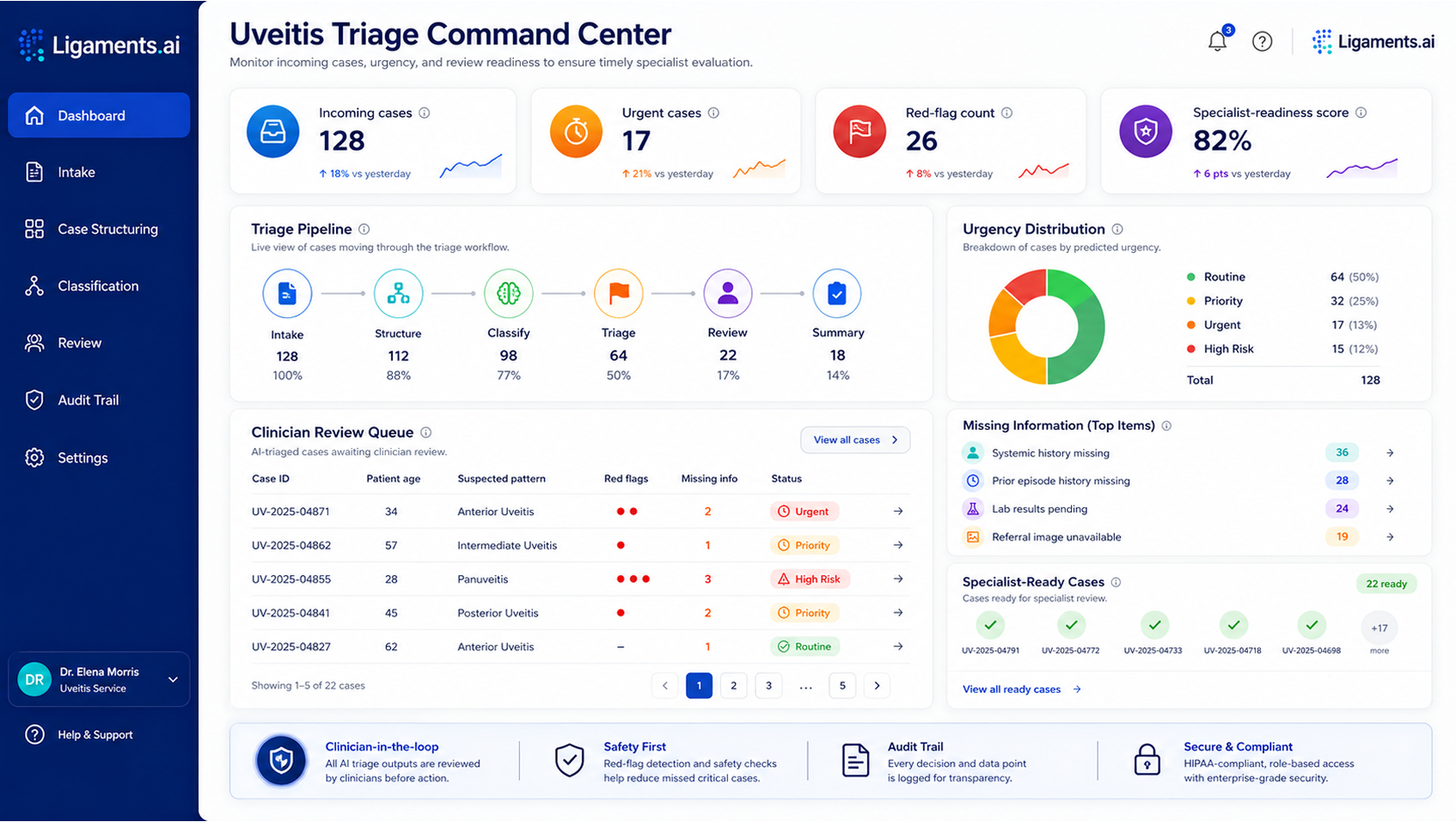 Sample Application Screens
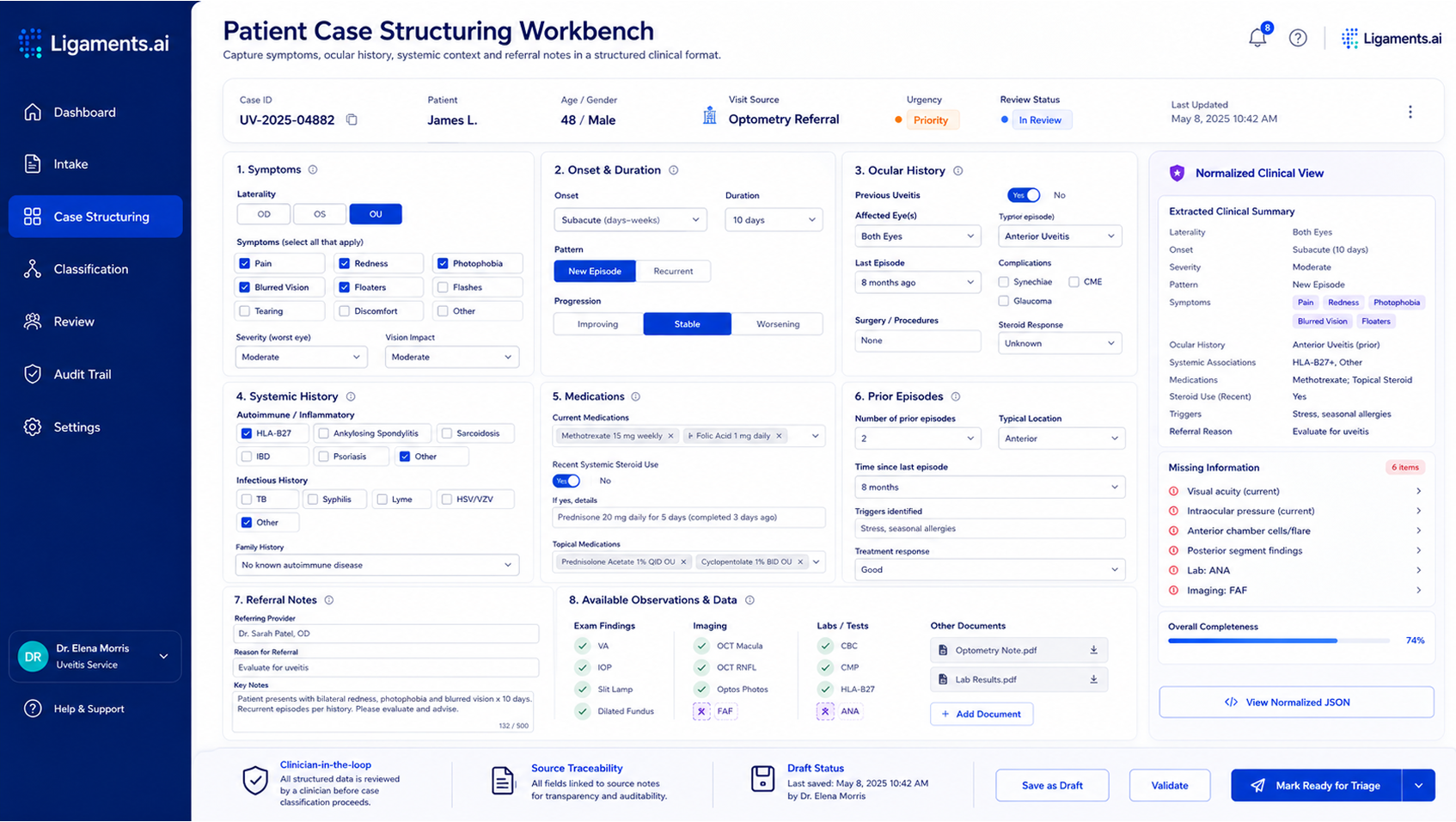 Sample Application Screens
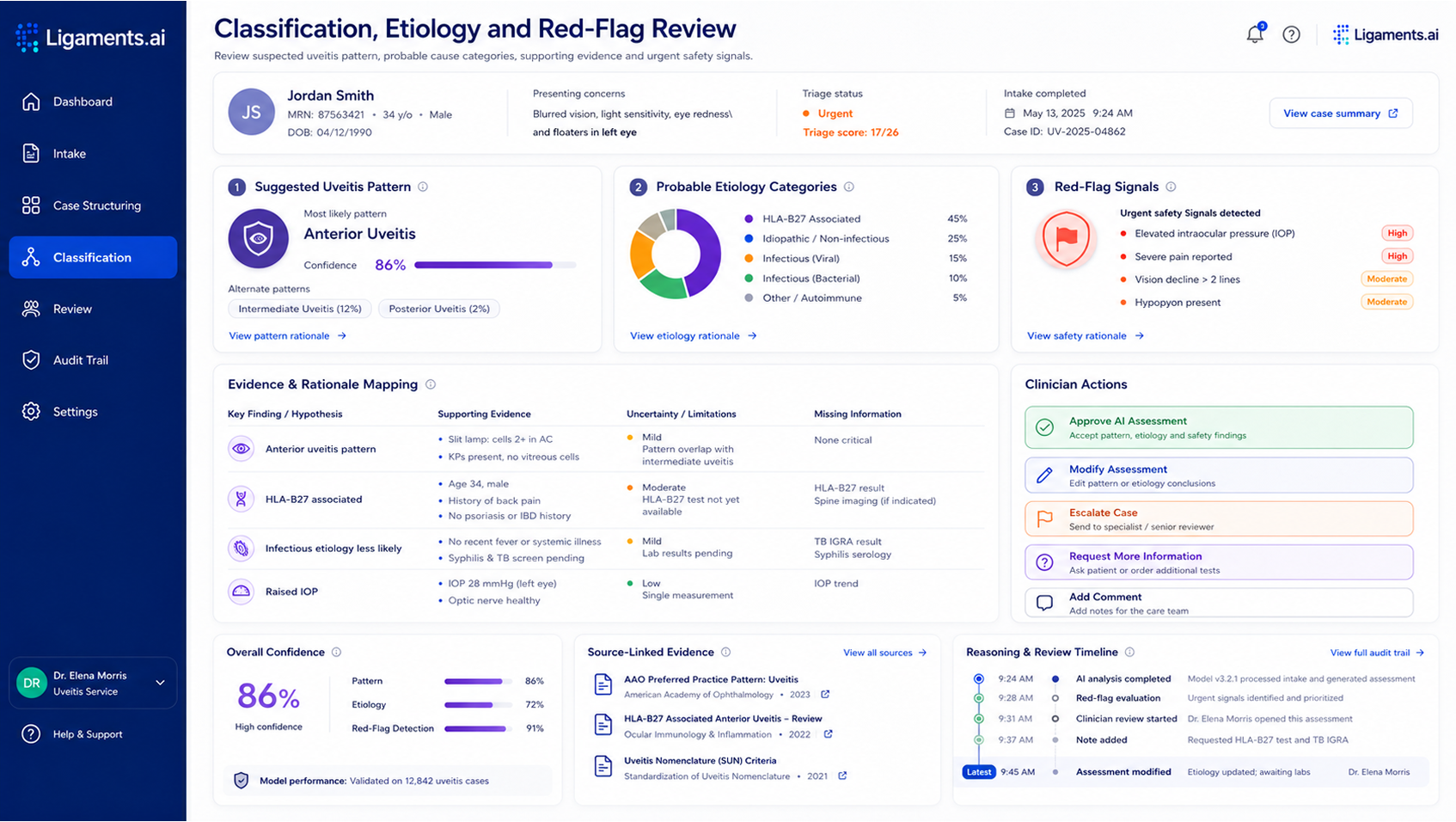 Sample Application Screens
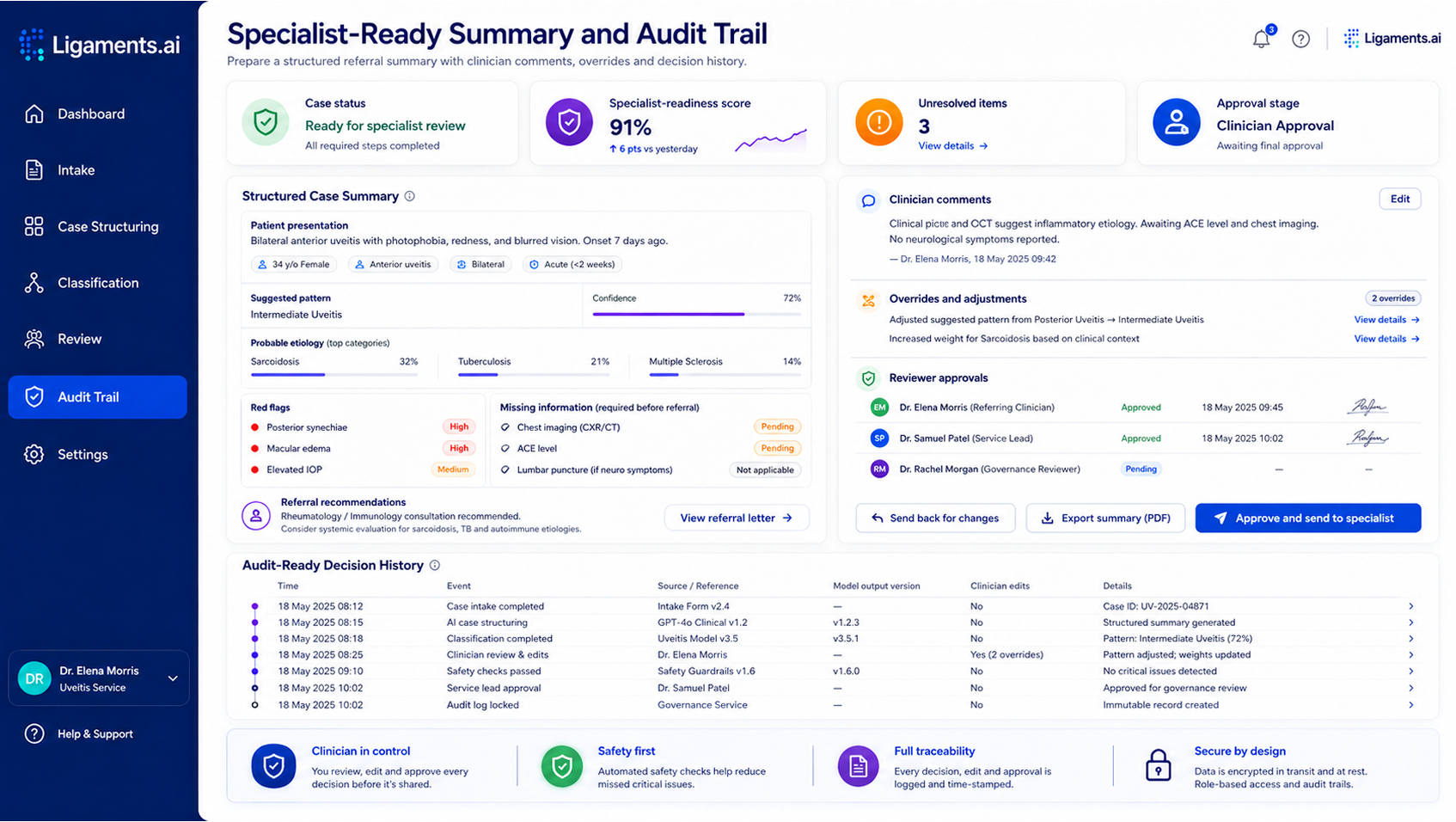 Sample Application Screens
From Fragmented Presentation to Specialist-Ready Case Preparation
Uveitis Clinical Intelligence Assistant helps care teams transform scattered patient information into clear, structured and review-ready case intelligence for specialist assessment.
Support more consistent case preparation, earlier visibility of information gaps and stronger clinical handoffs—while qualified clinicians remain responsible for interpretation, diagnosis, treatment and every patient-care decision.
Bring greater clarity, consistency and clinician control to uveitis case preparation.
Talk to Ligaments.ai to explore how clinician-governed Agentic AI can strengthen uveitis referral, case preparation and specialist-review workflows.