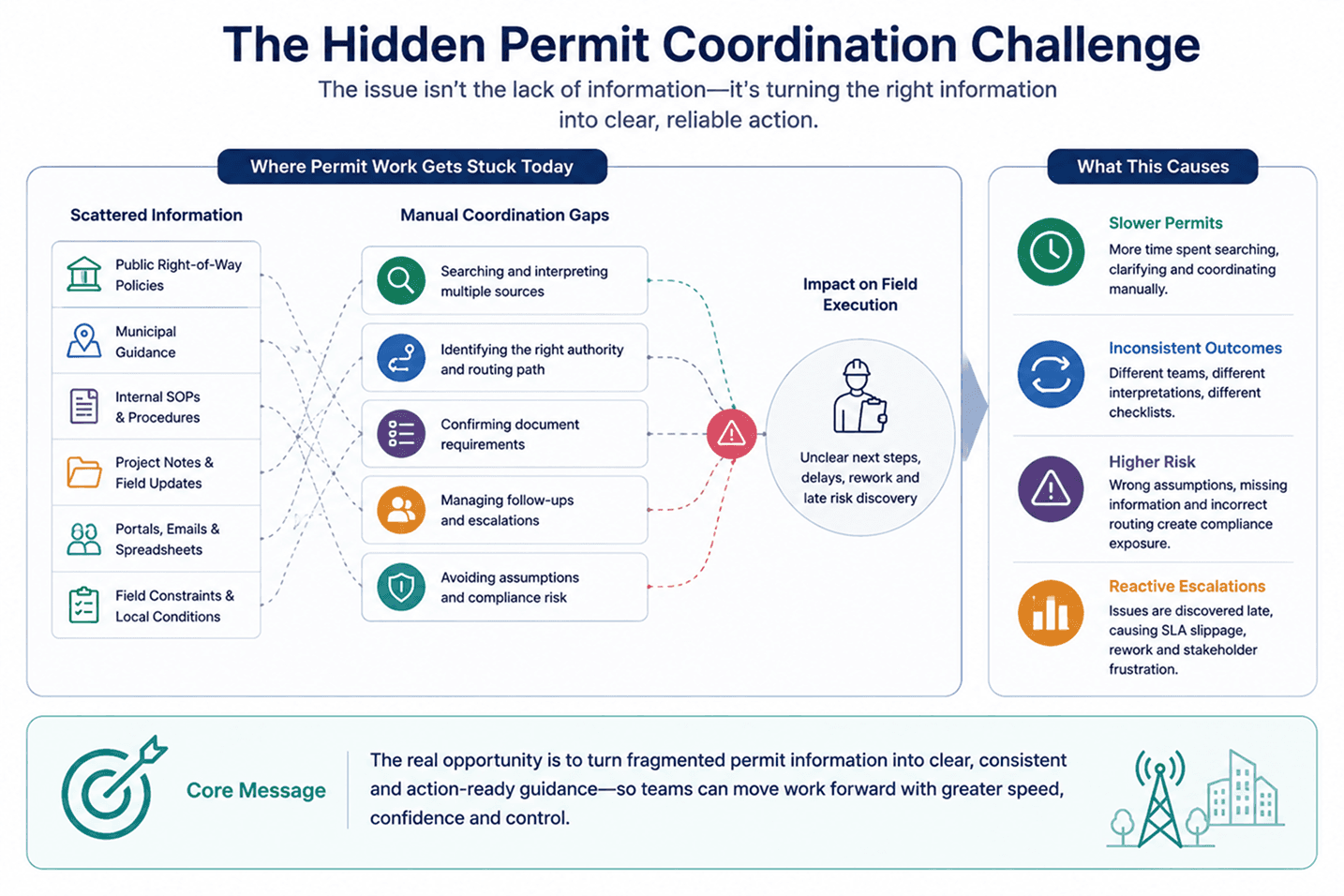

The assistant combines domain-adapted inventory intelligence, schema packs, governed retrieval, query guardrails, validation rules, human approval and audit trails. AI output becomes operational decision support that teams can review, validate and act on with confidence.
The Legacy Inventory Operations Gap
Legacy telecom inventory systems often hold the operational truth behind active services, circuits, resources, locations and order activity. The challenge is that this information is difficult to interpret, query and explain unless users understand legacy schemas, identifiers, inventory hierarchies and Legacy-specific workflows.
This creates friction across order management, service activation, engineering support, network operations and modernization teams. Investigations become slower, dependency on experienced specialists increases, and automation initiatives struggle when legacy data cannot be translated into clear, traceable operational context.
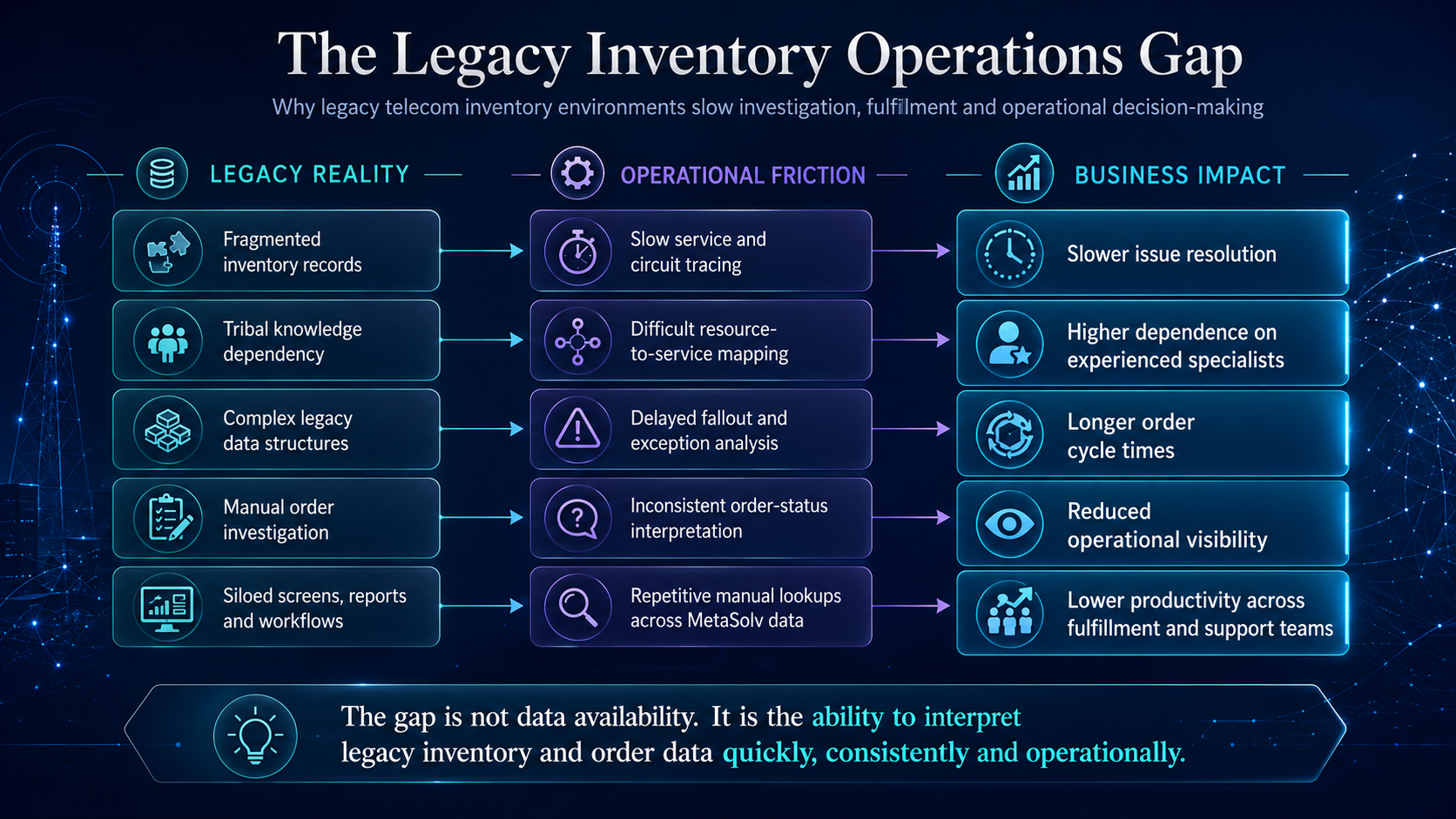 The Legacy Inventory Operations Gap
The real gap is not data availability. It is the ability to interpret legacy inventory and order data quickly, consistently and operationally.
From Legacy Inventory Complexity to Governed AI-Assisted Operations
Legacy and related environments already contain valuable inventory and order context. What operations teams need is a governed intelligence layer that can make this information easier to understand, search, validate and use in day-to-day workflows.
Legacy Inventory Assistant creates this bridge by interpreting legacy data structures, mapping service and resource relationships, translating operational intent into controlled retrieval actions, flagging data-quality concerns and producing source-backed responses.
The goal is not uncontrolled system modification. The goal is faster lookup, better investigation support, governed recommendations and audit-ready operational traceability.
From Legacy Complexity to Governed Operational Intelligence
Legacy Inventory Assistant is a governed Agentic AI solution that helps telecom operations teams make complex inventory and order information easier to understand, investigate and use.
It brings together relevant operational context to support faster issue investigation, clearer visibility across services and resources, improved identification of data-quality concerns and more consistent decision-making across order management, service activation, engineering support and network operations.
Domain-aware intelligence helps users move beyond fragmented records and specialist-dependent searches to obtain clear, source-backed operational insights. Controlled access, validation, human oversight and traceability are built into the solution so that enterprise systems and authorized users remain in control of sensitive and high-impact actions.
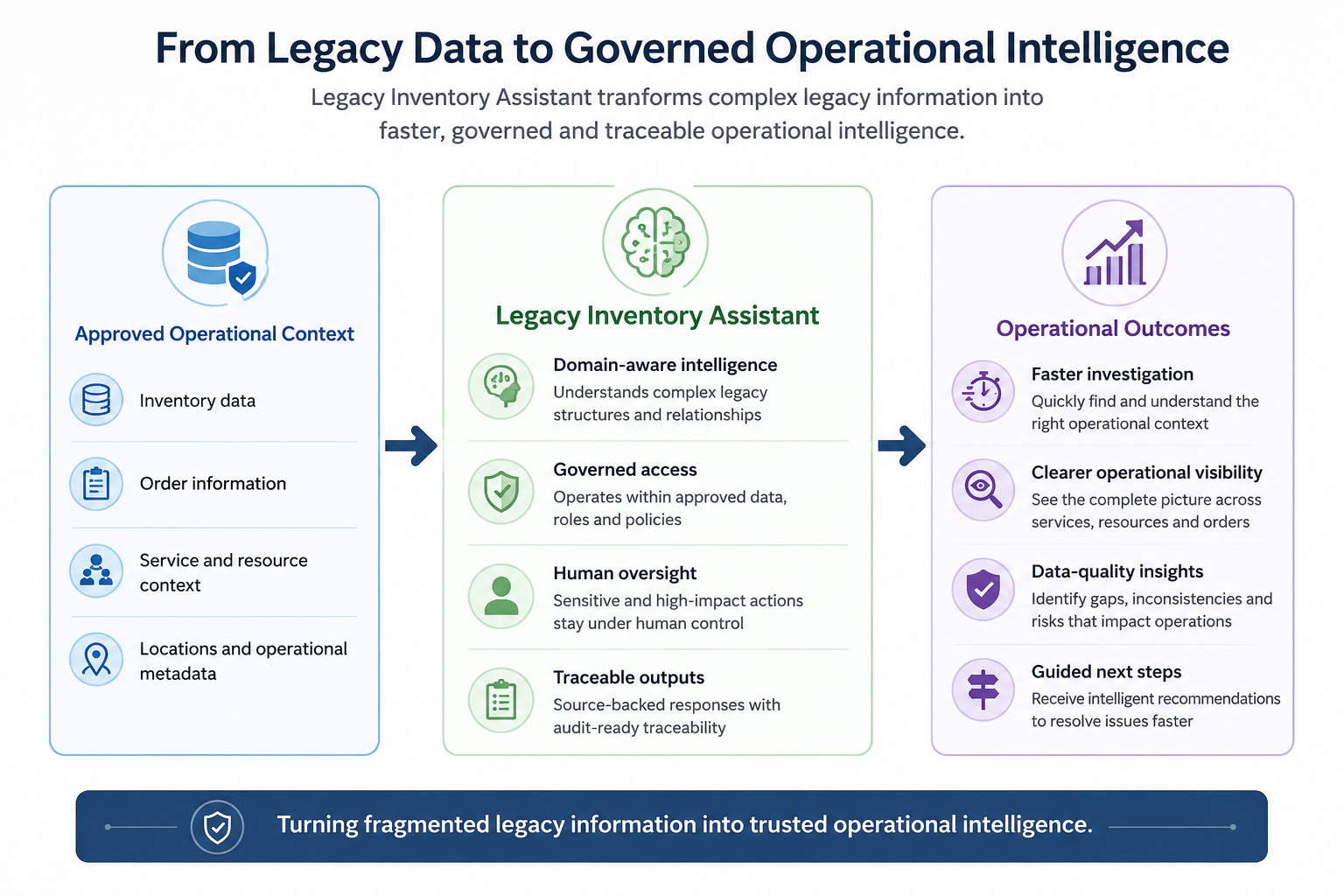 From Legacy Complexity to Governed Operational Intelligence
How the Solution Creates Value
Bring operational context together
Connect approved inventory, order, service and resource information into a more accessible operational view.
Understand relationships and issues
Interpret complex legacy information and highlight relevant relationships, inconsistencies and potential causes behind operational issues.
Support investigation and resolution
Help teams investigate order fallout, service issues, inventory gaps and data-quality concerns, with guided recommendations for the next appropriate step.
Maintain governance and traceability
Provide source-backed outputs within established access controls, validation requirements and human-approval processes.
Legacy Inventory Assistant transforms complex legacy information into faster, governed and traceable operational intelligence—reducing manual investigation and dependence on specialist knowledge.
Core Capabilities for Legacy Inventory Operations
Legacy Inventory Assistant helps telecom operations teams understand complex inventory information, find relevant operational context, investigate issues and identify data-quality concerns more efficiently.
It brings domain-aware intelligence, guided information access and governed operational support into a single experience—helping teams work with legacy information more consistently while established enterprise permissions and controls remain in place.
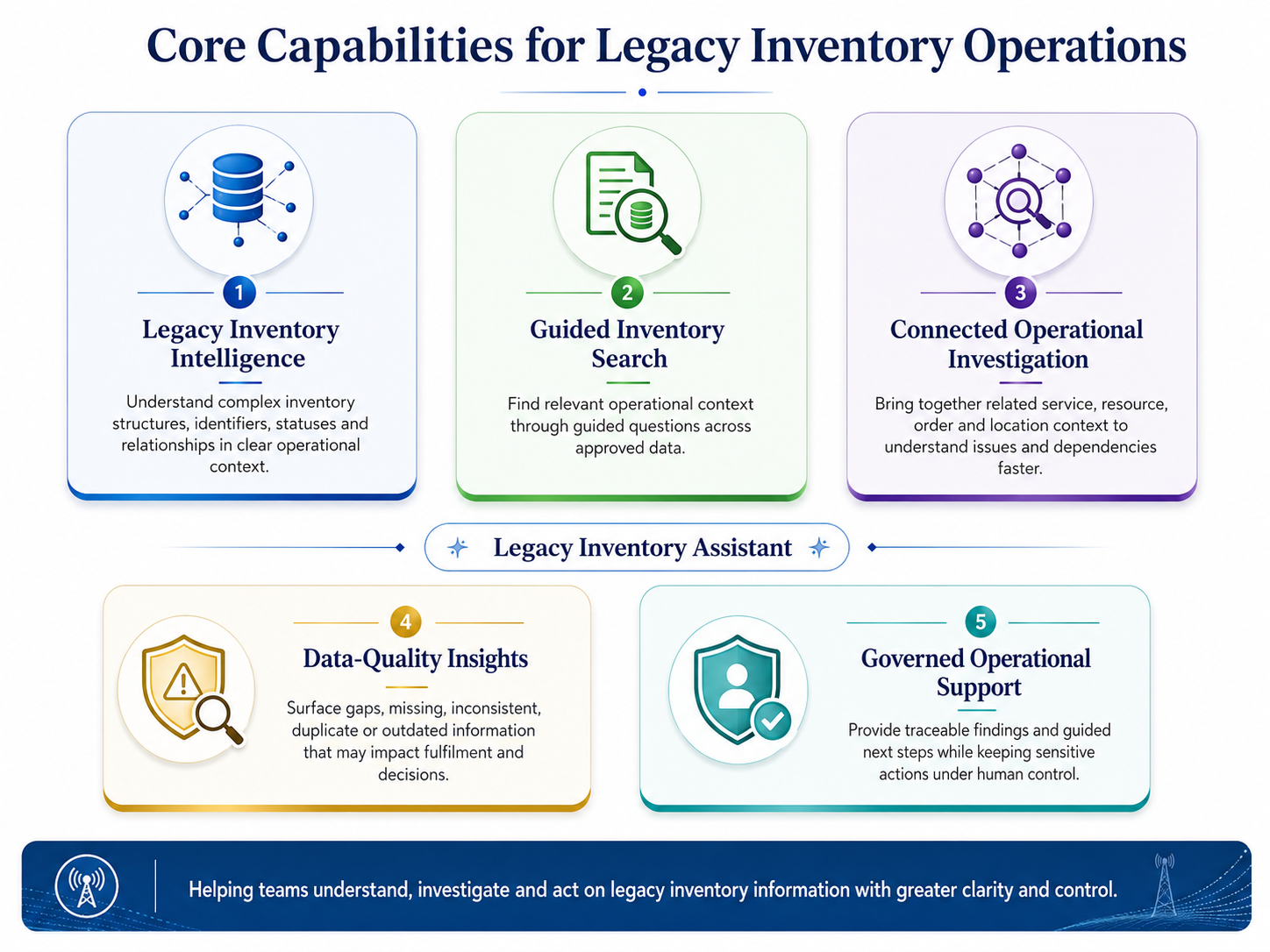 Core Capabilities for Legacy Inventory Operations
Legacy Inventory Assistant helps teams move from fragmented records and specialist-dependent investigation to clearer, faster and more consistent inventory operations.
Built for Real Operating Environments
Legacy Inventory Assistant is designed for teams that operate legacy inventory, service activation, order management, network operations and modernization workflows. It supports operational users who need faster access to trusted inventory context without giving AI uncontrolled authority over legacy systems.
-
Order management teams investigating fallout, delayed orders, data mismatch or missing inventory context.
-
Service activation teams that need to connect customer services, circuits, resources and provisioning context.
-
Engineering support and NOC teams that need clearer visibility into service-resource relationships.
-
Operations leaders seeking repeatable lookup, investigation and reporting processes across legacy systems.
-
Modernization teams preparing to bridge legacy data with new workflows, APIs, analytics and automation programs.
Impact and Key Results
Legacy Inventory Assistant is designed to improve legacy data access, order investigation, fallout triage and operational traceability. The following indicators can be used as pilot benchmarks, with actual results validated against data quality, schema coverage, workflow maturity and integration scope.
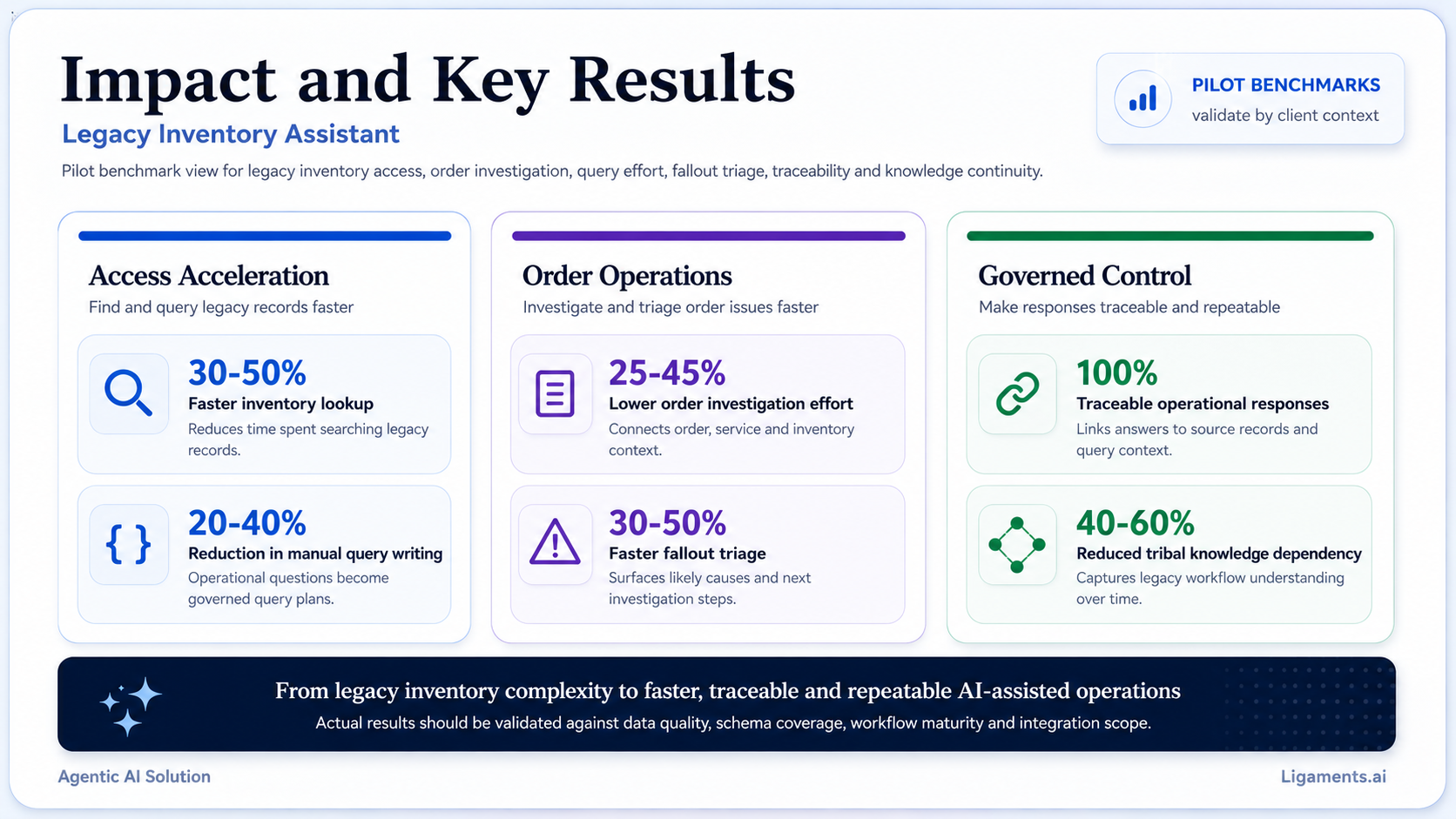 Impact and Key Results
Governed AI by Design
Legacy Inventory Assistant is built for controlled use around legacy systems. It does not bypass access controls, make uncontrolled inventory changes or replace system-of-record ownership.
The SLM interprets legacy context, rules validate query and action boundaries, humans approve high-impact actions, and audit logs preserve traceability.
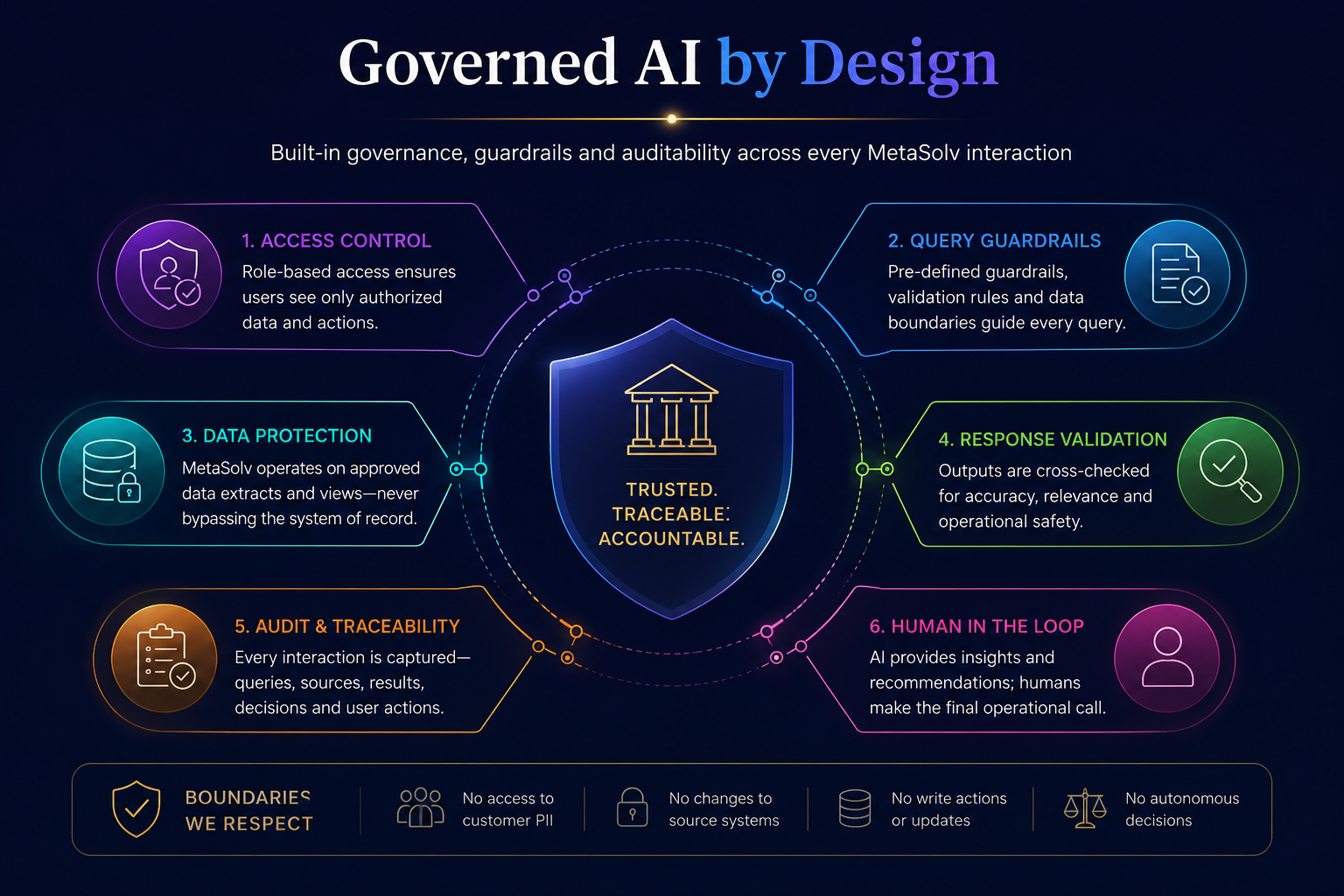 Governed AI by Design
AI assists interpretation and recommendation. Enterprise systems, validation rules and human users remain responsible for approvals, changes and system-of-record control.
Why Legacy Inventory Assistant by Ligaments.ai
Legacy Inventory Assistant by Ligaments.ai is built for telecom operations where legacy inventory knowledge, order context and system-of-record controls must be handled with precision. It brings domain-adapted intelligence, governed query handling and traceable workflow support to help teams interpret complex structures, investigate service and order issues, identify data-quality gaps and produce operationally usable outputs.
The solution is designed for real operating environments where AI must support users without bypassing access controls, replacing existing ownership or creating uncontrolled system changes.
Domain-Adapted Inventory Intelligence
Understands inventory structures, relationships, identifiers, statuses, hierarchy and workflows so complex legacy records can be explained in business and operations language.
Governed Natural-Language Access
Allows users to ask controlled questions over complex legacy inventory and order context, while query guardrails, access controls and approved data boundaries protect operational use.
Agentic Workflow Design
Separates the operating flow into intake, interpretation, retrieval, relationship mapping, validation, action recommendation and reporting, so each step remains structured, reviewable and traceable.
Built for Legacy Governance
Uses governed query handling, validation rules, human approval and audit logging to support AI-assisted operations without bypassing system-of-record ownership.
Traceable Outputs for Operating Teams
Produces source-backed responses, query history, record references, reviewer actions and operational summaries for operations, engineering support, order management, NOC and modernization teams.
Modernization Without Replacement
Bridges legacy knowledge with AI-assisted workflows while allowing existing legacy, reporting, workflow and system-of-record environments to remain in control.
Ligaments.ai helps telecom teams turn legacy inventory complexity into faster, governed and traceable AI-assisted operations.
Sample Application Screens
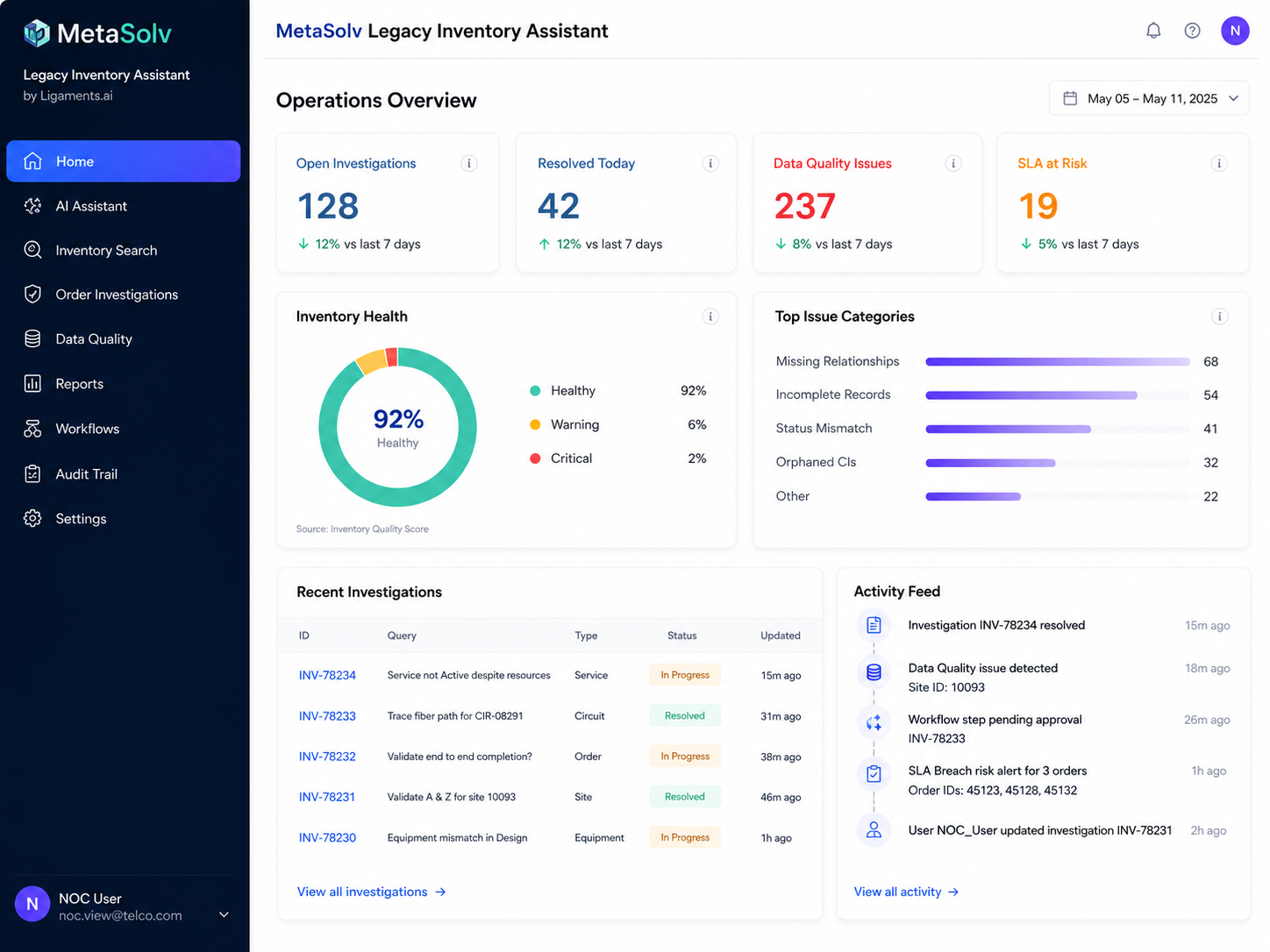 Sample Application Screens
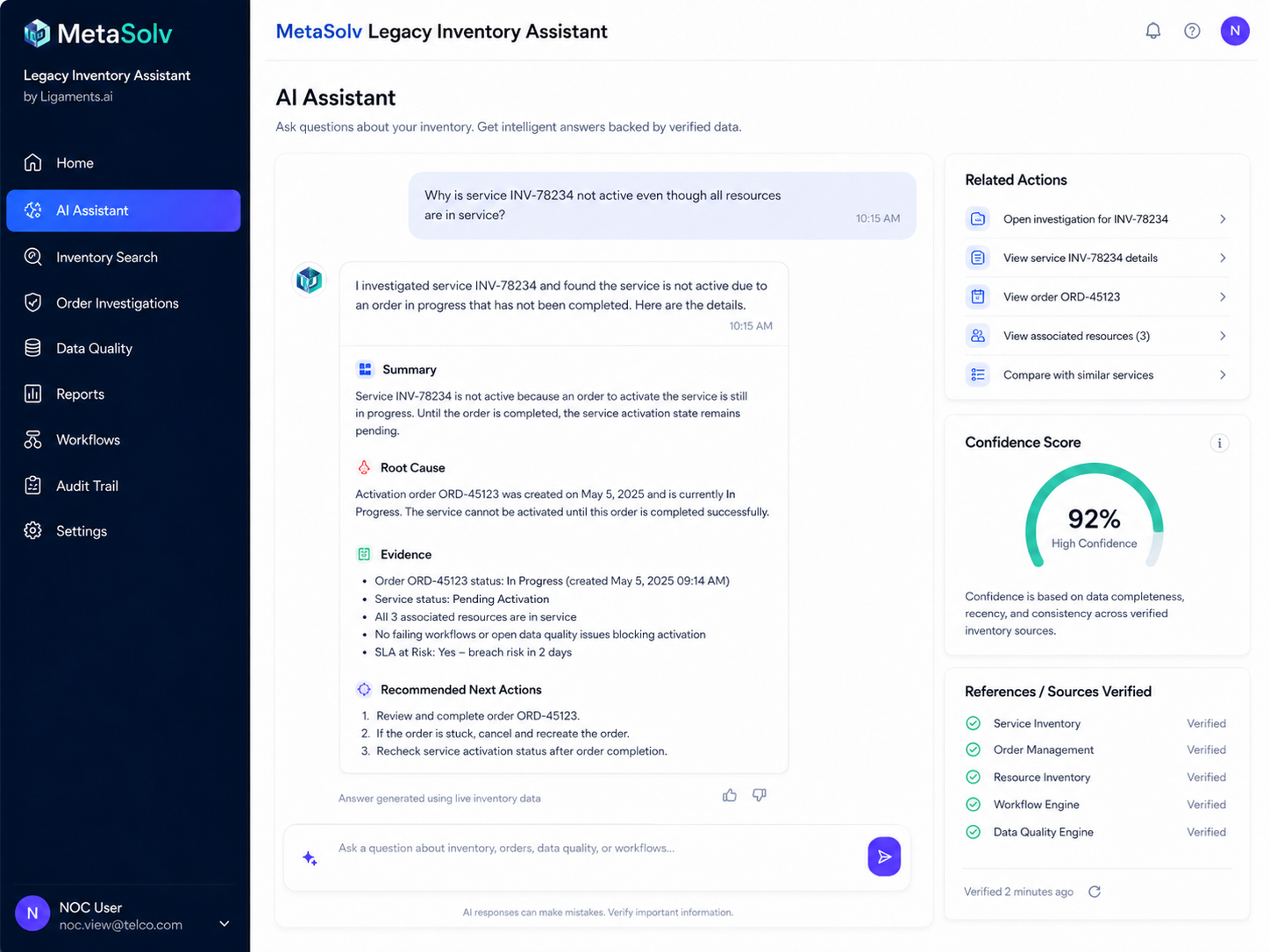 Sample Application Screens
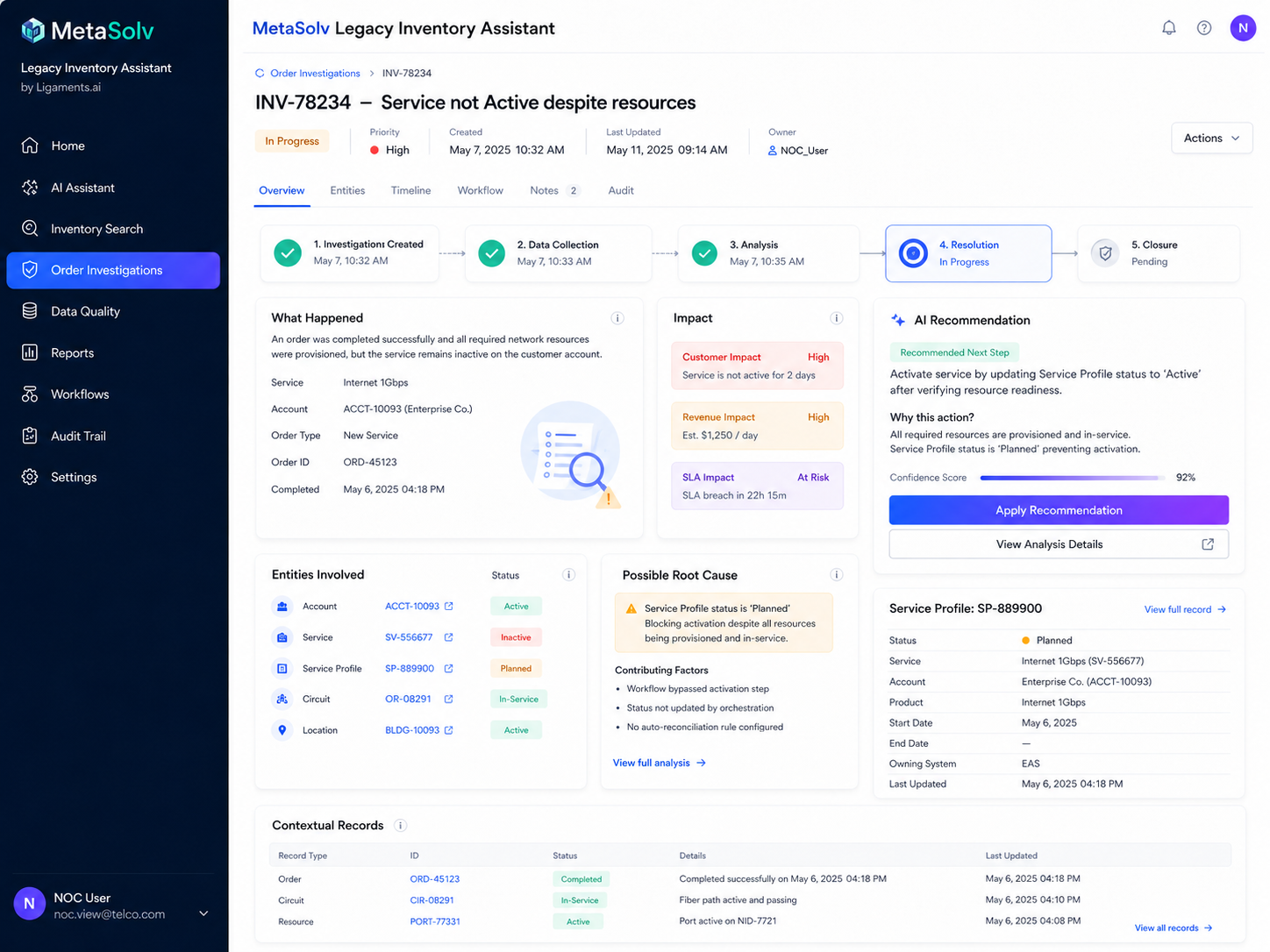 Sample Application Screens
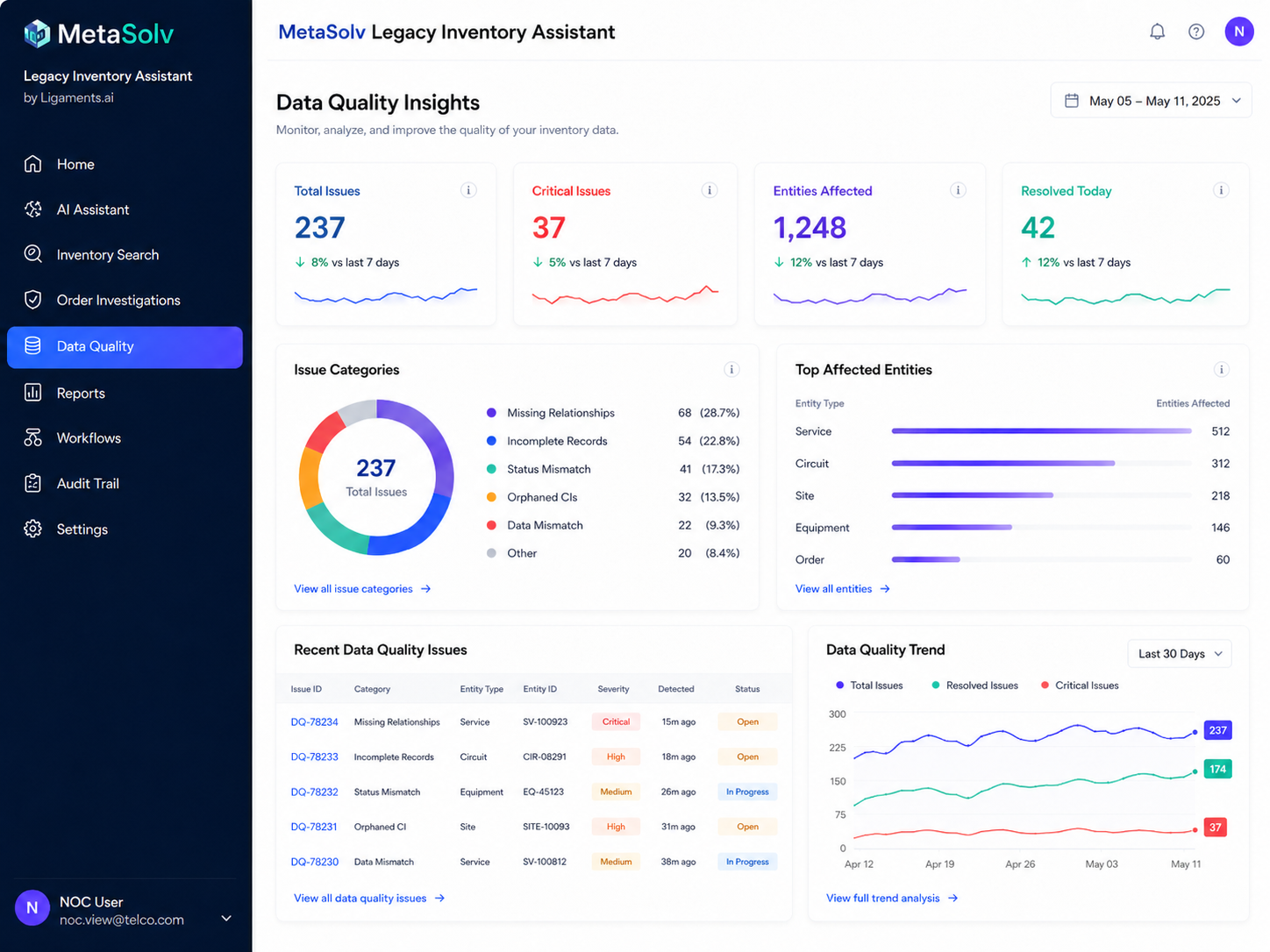 Sample Application Screens
Move from Legacy Inventory Complexity to Governed AI-Assisted Operations
Use Legacy Inventory Assistant to interpret inventory records, support order investigations, flag data-quality issues and produce traceable operational intelligence for legacy telecom environments.
Start with approved historical extracts and read-only investigation use cases. Then expand into workflow-assisted operations once governance, validation and human approval patterns are proven.
Explore how Ligaments.ai can help turn legacy inventory knowledge into governed AI-assisted operations.