

It helps transform fragmented presentation information into clear, structured and review-ready clinical intelligence that can support case preparation, referral handoff and specialist assessment.
Built for clinician-supervised use, the model can help surface relevant context and information gaps while qualified clinicians remain responsible for clinical interpretation, urgency assessment, diagnosis, treatment and all patient-care decisions.
Purpose-built clinical intelligence for uveitis case preparation—not autonomous diagnosis.
Why Generic AI Falls Short in Uveitis Clinical Workflows
Supporting uveitis care involves more than summarising symptoms or rewriting referral notes. Clinical teams may need to bring together ocular observations, presentation history, systemic context, previous episodes, medication exposure and supporting information to prepare the case, strengthen referral handoff and support efficient specialist assessment.
Generic AI may produce a fluent response, but it may not consistently recognise which details are clinically relevant, how information relates across the case or when specialist interpretation is required.
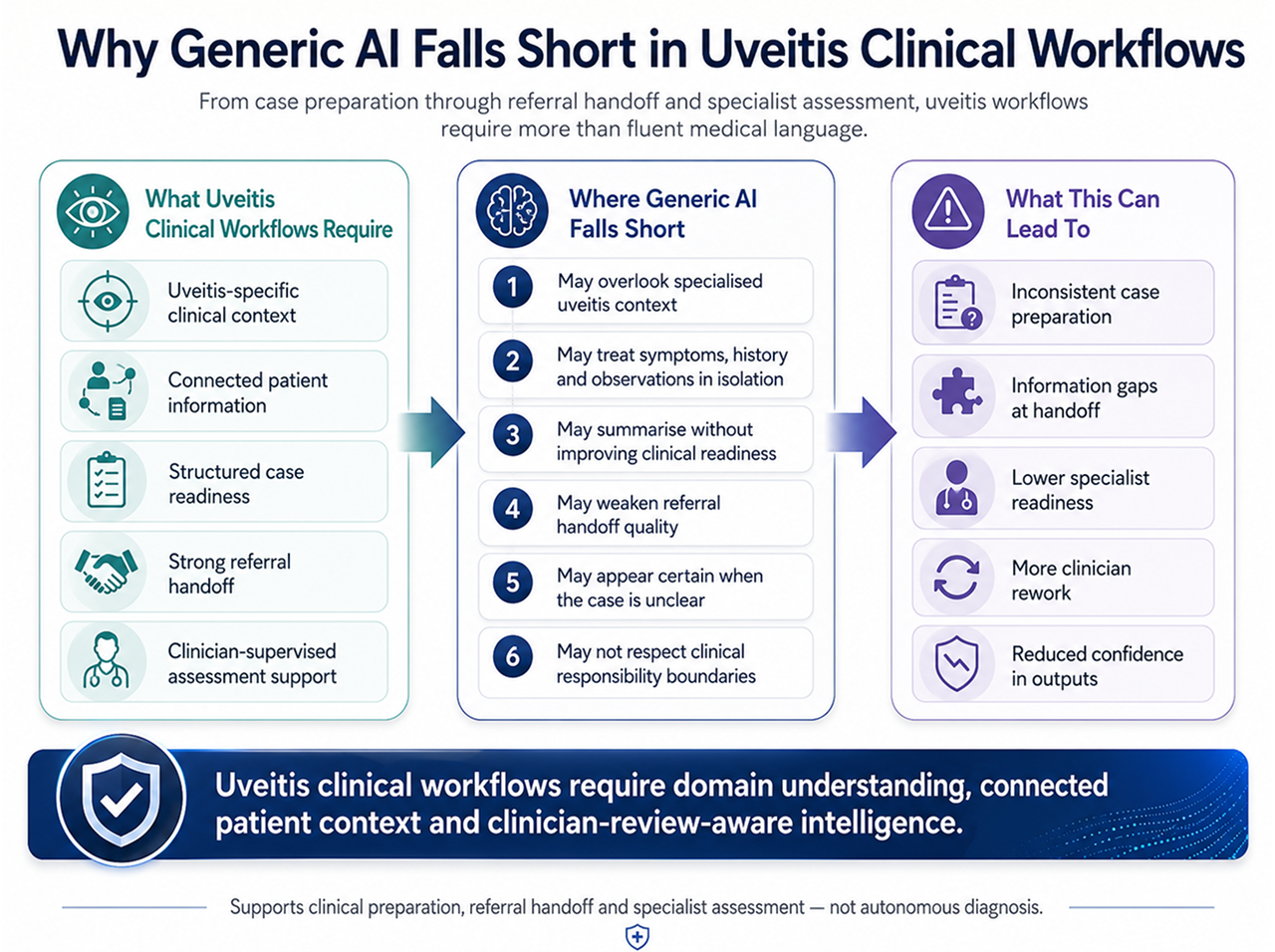 Why Generic AI Falls Short in Uveitis Clinical Workflows
Generic AI can summarise available information, but uveitis clinical workflows require specialised context, connected patient information and awareness of clinical responsibility boundaries. Without these capabilities, important information may be missed, referral handoffs may remain incomplete and clinicians may need to reconstruct the case before meaningful review can begin.
Uveitis Clinical Intelligence SLM is designed to support clearer case preparation, stronger referral handoff and more efficient specialist assessment while qualified clinicians retain responsibility for all clinical interpretation and patient-care decisions.
Uveitis clinical workflows require more than fluent medical language. They require domain understanding, connected patient context and clinician-review-aware intelligence.
What Uveitis Clinical Intelligence SLM Understands
Uveitis Clinical Intelligence SLM is designed to understand the specialised language, context and information relationships involved in uveitis case preparation, referral handoff and specialist assessment.
Rather than treating symptoms, history, observations and referral notes as isolated information, it interprets how the available details connect within the wider patient and clinical context. This enables clearer, more consistent and review-ready clinical intelligence for clinician-supervised workflows.
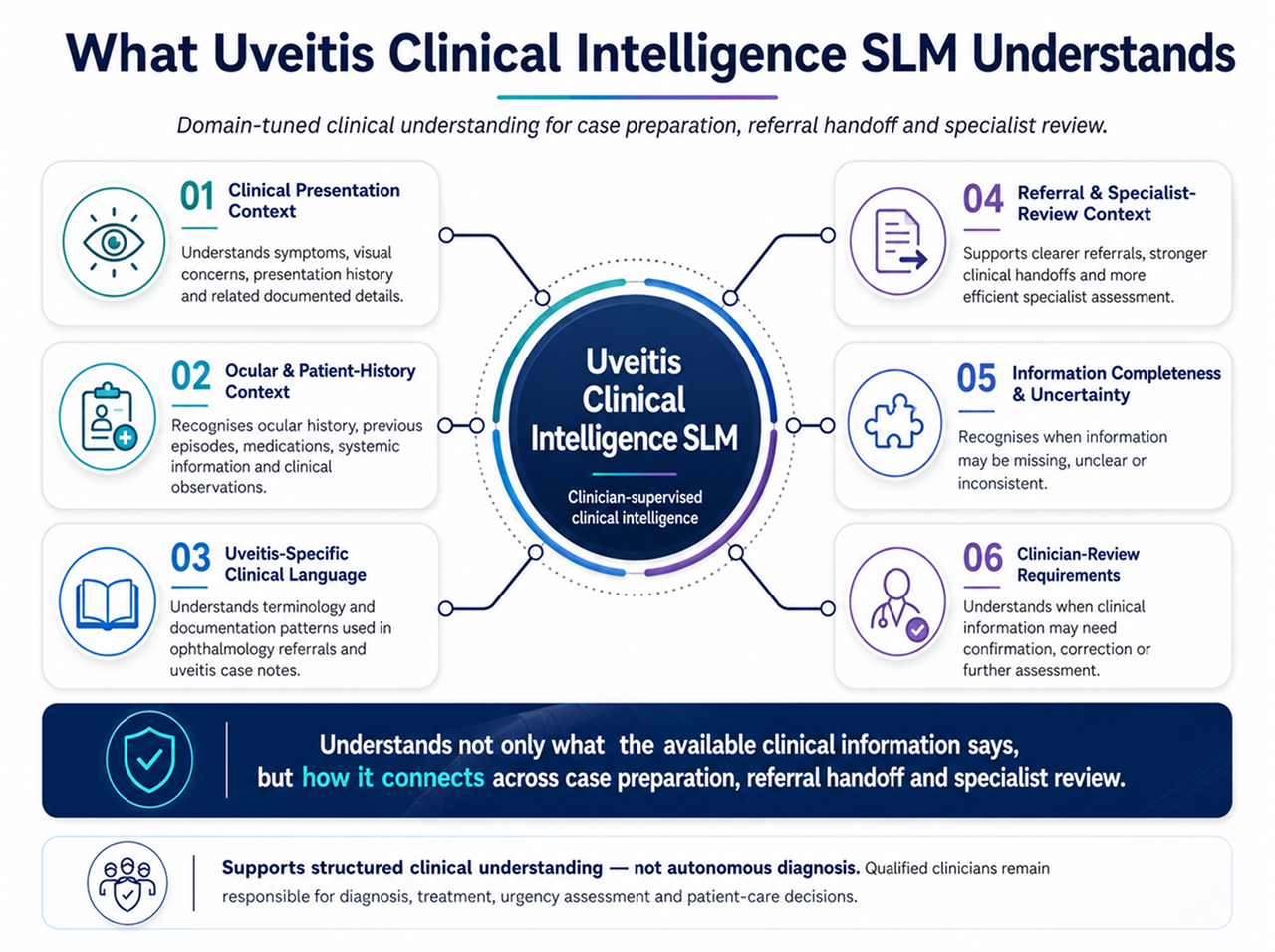 What Uveitis Clinical Intelligence SLM Understands
Uveitis Clinical Intelligence SLM brings together clinical presentation details, ocular and patient history, uveitis-specific terminology and referral information into a more connected view of the case.
It helps clinical teams prepare clearer case information, strengthen referral handoffs and support more efficient specialist review. The model also recognises when available information may be incomplete, unclear or require further clinical interpretation.
The SLM supports structured clinical understanding and preparation. It does not independently determine urgency, diagnosis, treatment or patient-care actions. These responsibilities remain with qualified clinicians.
Uveitis Clinical Intelligence SLM understands not only what the available clinical information says, but how it connects across case preparation, referral handoff and specialist review.
From Clinical Understanding to Clinician-Governed Use
Clinical intelligence creates value only when it can support care teams with appropriate oversight, accountability and professional judgment.
Uveitis Clinical Intelligence SLM interprets available presentation information within the wider context of patient history, ocular observations, referral needs and specialist review. It transforms this understanding into structured, review-ready intelligence that can support case preparation and clinical handoff.
Context-aware interpretation
Helps clinical teams understand how symptoms, history, observations and referral information connect within the wider case context.
Structured clinical intelligence
Converts fragmented information into a clearer and more consistent view that can support case preparation and specialist assessment.
Review-aware support
Recognises when available information may be incomplete, uncertain or require further clinical interpretation before it is used.
Clinician-governed use
The SLM supports clinical workflows while qualified clinicians remain responsible for urgency assessment, diagnosis, treatment and all patient-care decisions.
The model prepares and organises clinical intelligence. It does not independently determine clinical conclusions, approve care actions or replace established clinical processes.
Uveitis Clinical Intelligence SLM bridges the gap between complex patient information and clearer, clinician-reviewed case preparation.
What the SLM Produces
Uveitis Clinical Intelligence SLM transforms fragmented clinical information into clear, structured and review-ready intelligence that can support case preparation, referral handoff and specialist assessment.
Rather than producing generic summaries or independent clinical conclusions, it organises the available context so qualified clinicians can review the case more efficiently, identify information gaps and determine the appropriate clinical next steps.
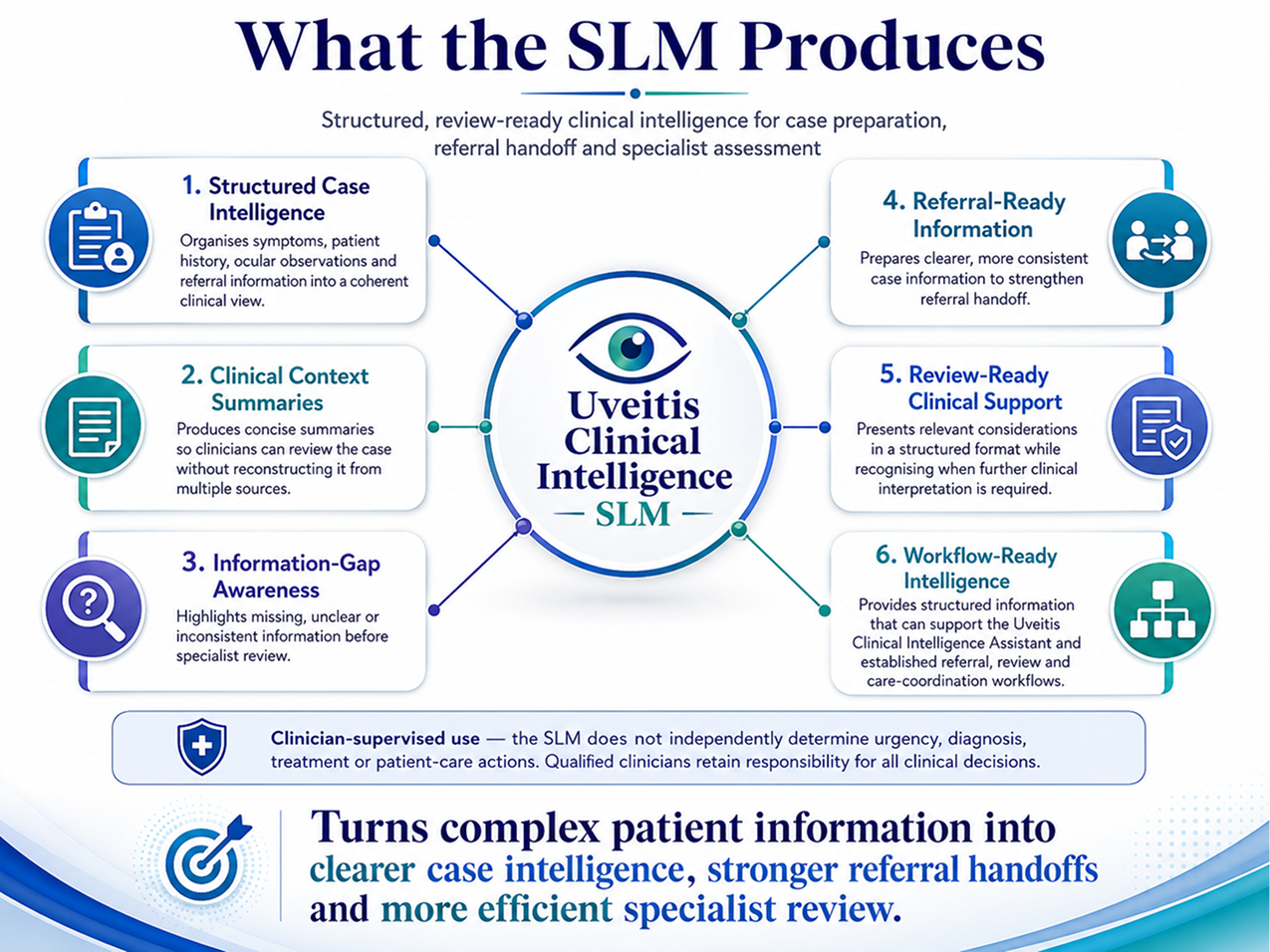 What the SLM Produces
Uveitis Clinical Intelligence SLM produces structured case intelligence, concise clinical summaries, information-gap awareness and referral-ready context that can support clinician-supervised review and established clinical workflows.
Its outputs are designed to help care teams prepare clearer cases, strengthen referral handoffs and support more efficient specialist assessment.
The SLM does not independently determine urgency, diagnosis, treatment or patient-care actions. Qualified clinicians retain responsibility for all clinical interpretation and decisions.
Uveitis Clinical Intelligence SLM turns complex patient information into clearer case intelligence, stronger referral handoffs and more efficient specialist review.
Built to Fit Existing Clinical Workflows
Uveitis Clinical Intelligence SLM is designed to bring specialised uveitis intelligence into the clinical tools and processes care teams already use.
Its structured, review-ready outputs can support the Uveitis Clinical Intelligence Assistant as well as established referral, case-preparation, specialist-review and care-coordination workflows.
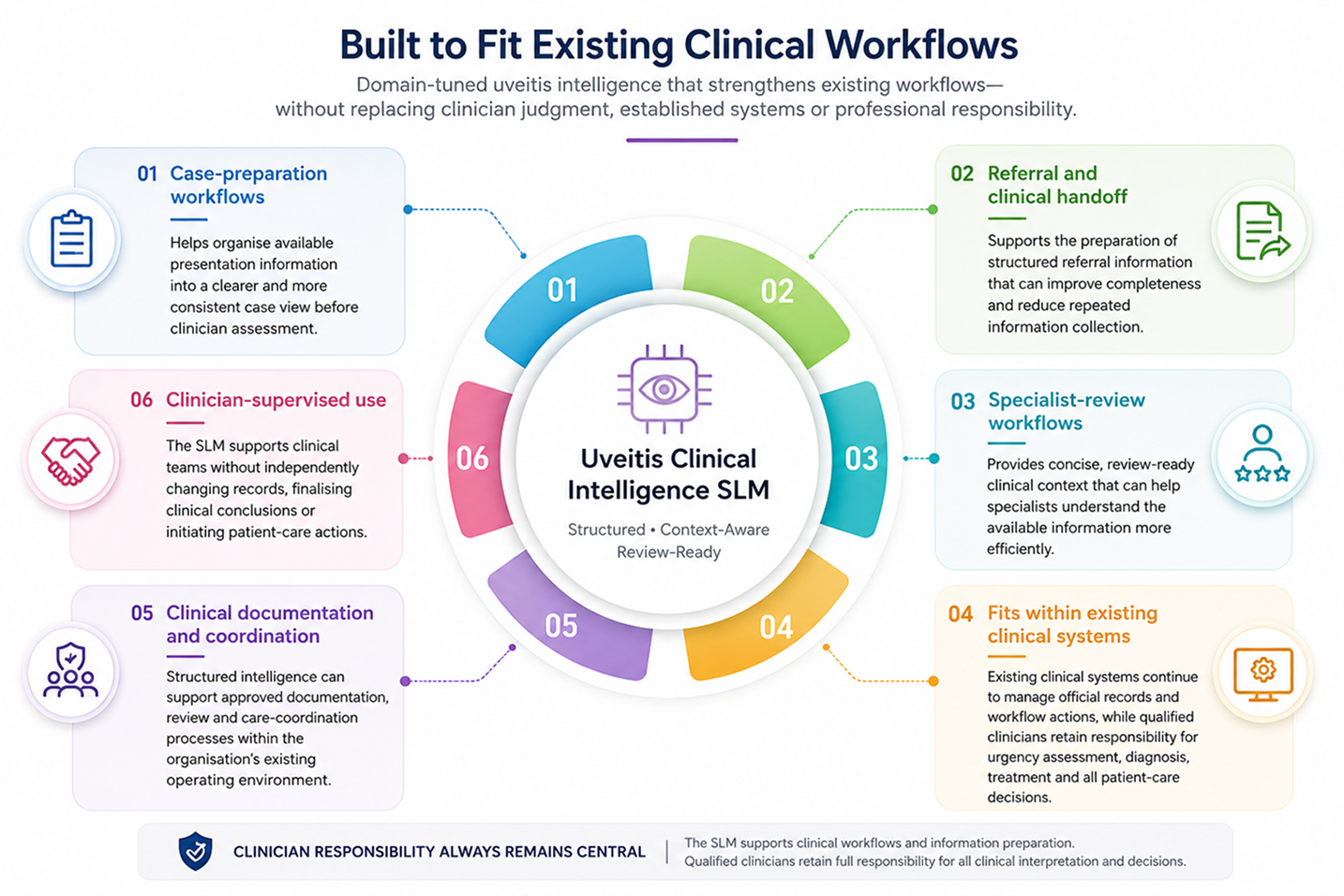 Built to Fit Existing Clinical Workflows
Uveitis Clinical Intelligence SLM strengthens existing clinical workflows by helping teams organise case information, prepare clearer referrals and provide more consistent context for specialist review.
The capability can support approved documentation, review and care-coordination processes without independently changing clinical records, finalising conclusions or initiating patient-care actions.
Existing clinical systems remain responsible for official records and workflow actions, while qualified clinicians retain responsibility for urgency assessment, diagnosis, treatment and all patient-care decisions.
Domain-tuned uveitis intelligence that strengthens existing clinical workflows—without replacing clinician judgment, established systems or professional responsibility.
Measurable Value: Model Quality and Clinical Workflow Impact
The value of Uveitis Clinical Intelligence SLM should be measured at two levels: first, whether it produces reliable, relevant and review-ready intelligence from available uveitis case information; and second, whether that intelligence improves case preparation, referral handoff and specialist-review workflows.
Model quality demonstrates that the SLM understands uveitis-specific language and clinical context, organises information consistently and recognises when further clinician interpretation is required.
Clinical workflow impact demonstrates whether this intelligence helps care teams prepare cases more efficiently, identify information gaps earlier, improve referral completeness and provide specialists with clearer context—without weakening clinician judgment, professional accountability or patient-care responsibility.
SLM Quality Indicators
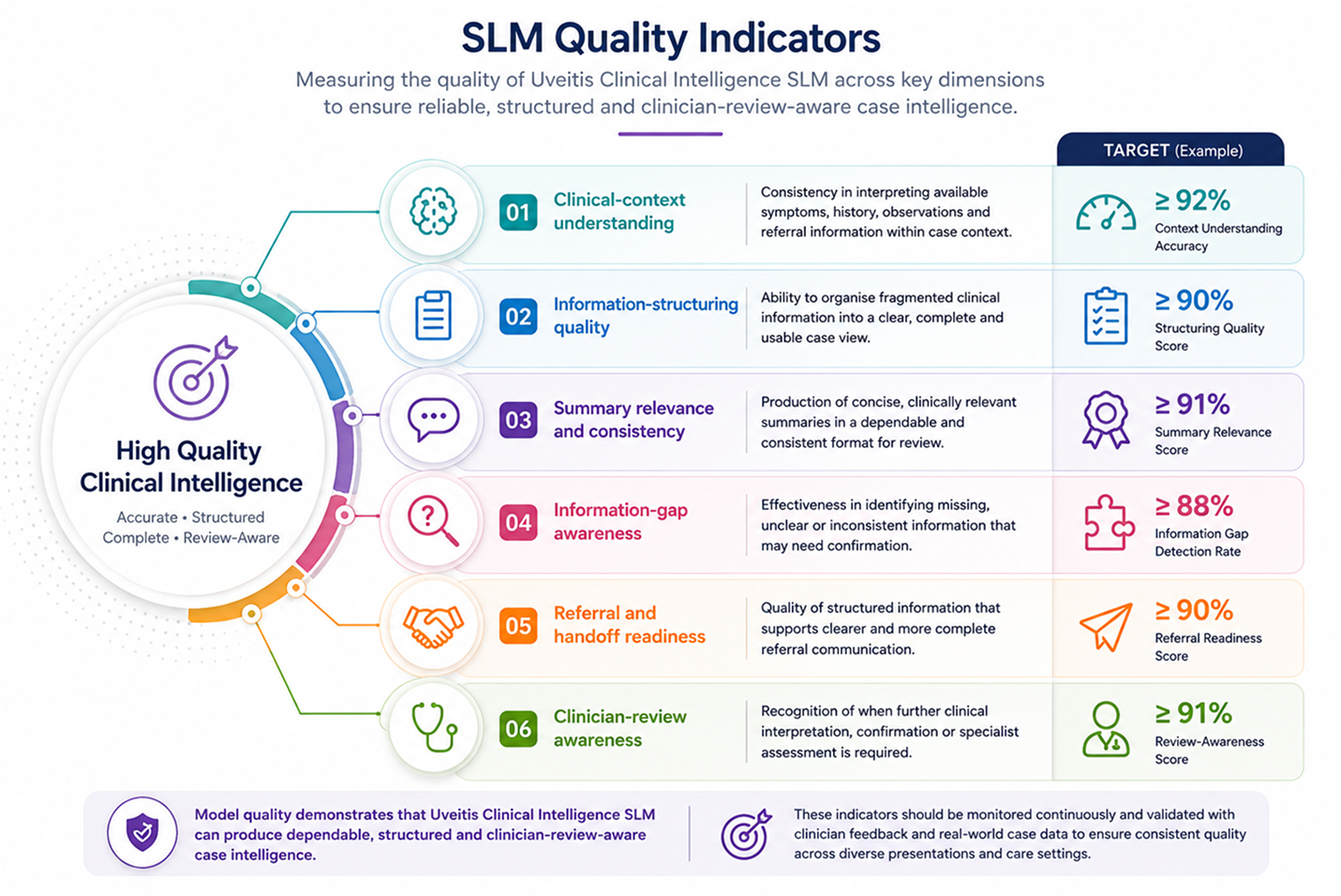
SLM quality indicators measure whether Uveitis Clinical Intelligence SLM produces information that clinical teams can rely on within clinician-supervised workflows.
The focus is not simply on whether the model generates a response. It should correctly interpret the available case context, organise information consistently, produce clinically relevant summaries and identify situations where information may be incomplete, unclear or require further assessment.
 SLM Quality Indicators
Model quality demonstrates that Uveitis Clinical Intelligence SLM can produce dependable, structured and clinician-review-aware case intelligence.
Operational Outcomes Enabled by the SLM
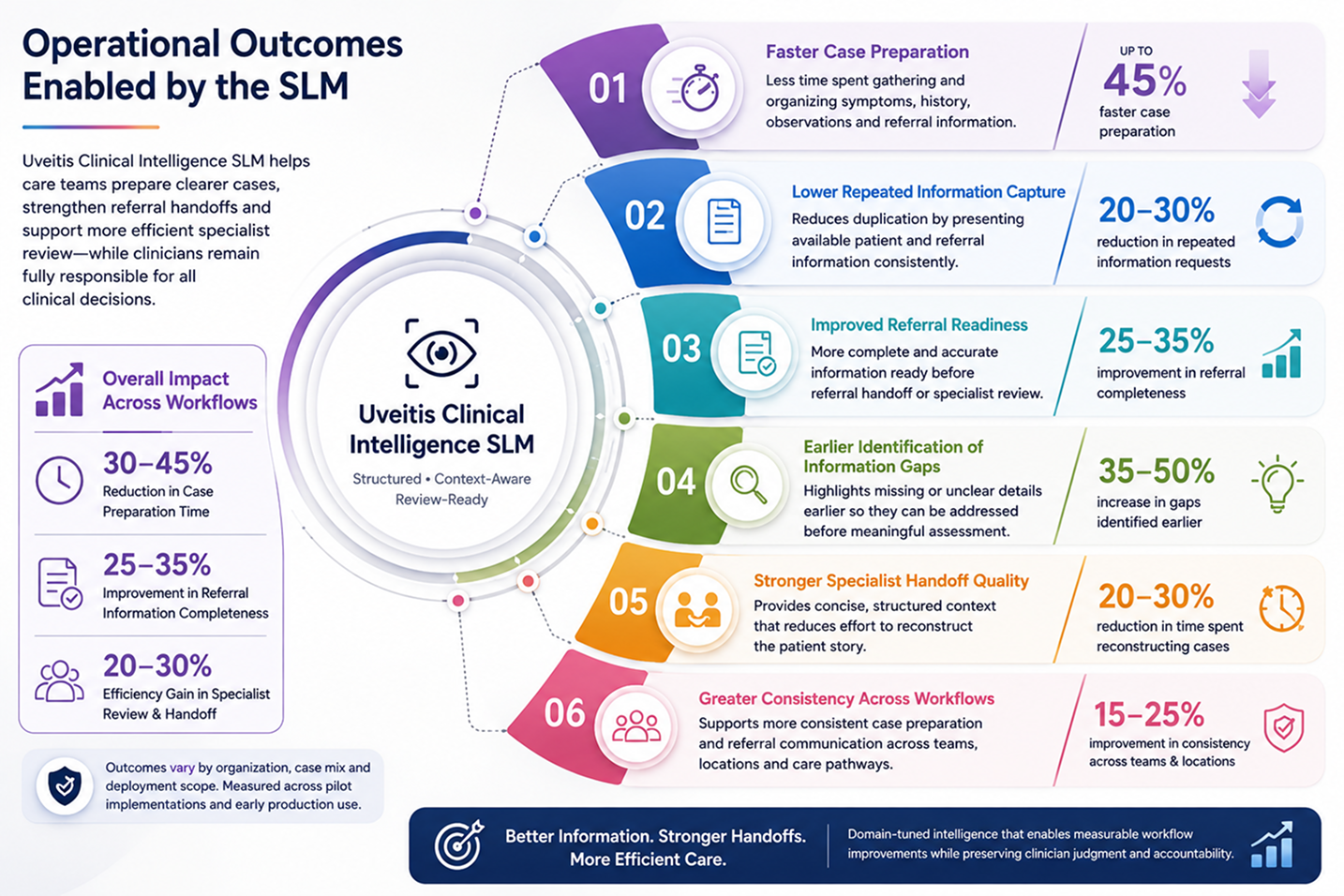
Operational outcomes measure how Uveitis Clinical Intelligence SLM improves day-to-day clinical information preparation when its intelligence is used within approved, clinician-supervised workflows.
The focus is not only on model quality, but on whether structured and review-ready outputs help care teams prepare cases faster, reduce repeated information collection, improve referral completeness, identify information gaps earlier and provide specialists with clearer clinical context.
 Operational Outcomes Enabled by the SLM
Clinical workflow impact demonstrates that domain-tuned intelligence can help teams prepare clearer cases, strengthen referral handoffs and support more efficient specialist review—while clinicians remain fully responsible for all clinical decisions.
Clinician-Governed by Design
Uveitis Clinical Intelligence SLM is designed for clinical environments where patient safety, professional accountability and human oversight are essential.
It supports structured case preparation, referral handoff and specialist review while qualified clinicians remain responsible for urgency assessment, clinical interpretation, diagnosis, treatment and all patient-care decisions.
Clinician oversight remains central
SLM-generated intelligence is prepared to support clinician review. It is not treated as an independent clinical conclusion or patient-care decision.
Evidence-aware clinical support
The model organises available case information so clinicians can understand the context behind summaries and recognise where supporting information may be limited.
Uncertainty and information gaps remain visible
When information is incomplete, unclear or inconsistent, the SLM can highlight the need for further information or clinical assessment rather than presenting unsupported conclusions as final.
Responsible information handling
The SLM is designed to operate within the healthcare organisation’s established requirements for patient information, access control, privacy and clinical governance.
Existing clinical authority remains intact
Clinical systems continue to manage official patient records and workflow actions. Qualified clinicians and healthcare organisations retain control over referrals, escalation, diagnosis, treatment and patient communication.
Accountable clinical use
The model’s intelligence supports clearer case preparation and specialist review while established clinical processes and professional responsibilities remain authoritative.
Trusted, review-ready clinical intelligence that strengthens uveitis workflows—without replacing clinician judgment, clinical accountability or patient-care responsibility.
Flexible Deployment, Built Around Your Clinical Environment
Uveitis Clinical Intelligence SLM can be introduced in a way that aligns with each organisation’s clinical workflows, technology environment, privacy requirements and governance expectations.
It is designed to bring specialised uveitis intelligence into existing case-preparation, referral and specialist-review processes without requiring disruptive system replacement or changing established clinical responsibilities.
Within Uveitis Clinical Intelligence Assistant
The SLM can provide the domain-tuned intelligence that supports structured case preparation, referral readiness and clinician-reviewed specialist support within the complete solution.
Within existing clinical workflows
Its review-ready intelligence can support approved referral processes, clinical review tools, care-coordination workflows and documentation environments already used by the organisation.
Secure, client-aligned deployment
Deployment can be aligned with institutional expectations for patient-data protection, access control, infrastructure, privacy and clinical governance.
Adapted to local care pathways
The capability can support different intake practices, referral formats, clinical terminology, specialist-review processes and organisational operating models.
Focused initial adoption
Organisations can begin with a clearly defined case-preparation or referral-support requirement and assess the quality and usefulness of the SLM under clinician supervision.
Phased expansion
Adoption can expand progressively as clinical confidence, workflow readiness and governance maturity develop.
Existing clinical systems continue to manage official patient records and workflow actions. Qualified clinicians remain responsible for urgency assessment, diagnosis, treatment and every patient-care decision.
Start with a focused clinical need. Validate quality under clinician supervision. Expand with confidence.
Why Ligaments.ai
Ligaments.ai brings a domain-first, clinician-governed approach to AI for complex healthcare workflows.
Uveitis Clinical Intelligence SLM is designed specifically for structured case preparation, referral handoff and specialist review—not as a generic medical-language model or autonomous diagnostic system.
Purpose-built clinical intelligence
The SLM is tuned to understand the specialised language, context and information relationships found in uveitis referrals and clinical case documentation.
Designed for practical clinical use
It transforms fragmented patient and referral information into clearer, structured and review-ready intelligence that can support real clinical workflows.
Clinician-governed by design
Qualified clinicians remain responsible for clinical interpretation, urgency assessment, diagnosis, treatment and every patient-care decision.
Review-aware and responsible
The model recognises when information may be incomplete, unclear or require further clinical assessment rather than presenting unsupported conclusions as final.
Adaptable to different care environments
The capability can align with different intake practices, referral pathways, specialist-review processes, clinical terminology and organisational governance expectations.
Built to strengthen existing workflows
Uveitis Clinical Intelligence SLM can support the Uveitis Clinical Intelligence Assistant and established case-preparation, referral, documentation and care-coordination workflows without replacing existing clinical systems.
Focused on measurable clinical-workflow value
The objective is to help care teams prepare cases more efficiently, improve referral completeness, identify information gaps earlier and provide specialists with clearer clinical context.
Ligaments.ai combines domain-tuned clinical intelligence, clinician-governed design and practical workflow alignment to help care teams bring AI into uveitis clinical workflows with confidence.
Bring Domain-Tuned AI into Uveitis Clinical Workflows
Uveitis Clinical Intelligence SLM helps care teams transform fragmented patient and referral information into structured, review-ready intelligence for case preparation, clinical handoff and specialist assessment.
Bring greater clarity, consistency and efficiency to uveitis workflows while qualified clinicians remain responsible for urgency assessment, diagnosis, treatment and every patient-care decision.
Prepare clearer cases. Strengthen referral handoffs. Support more efficient specialist review.
Talk to Ligaments.ai to explore how Uveitis Clinical Intelligence SLM can bring domain-tuned, clinician-governed AI into your existing clinical environment.