Domain-Tuned Intelligence, Built for Controlled Use
Legacy Inventory SLM is Ligaments.ai domain-adapted model capability for interpreting legacy inventory data and supporting telecom order operations. It is designed for teams that need structured understanding of legacy data, not generic database chat.
The SLM is not positioned as a system of record, standalone automation engine or replacement for expert users. It acts as the domain intelligence layer that converts prepared inputs into structured, explainable, review-aware signals for governed workflows.
Why Generic AI Falls Short with Legacy Inventory Systems
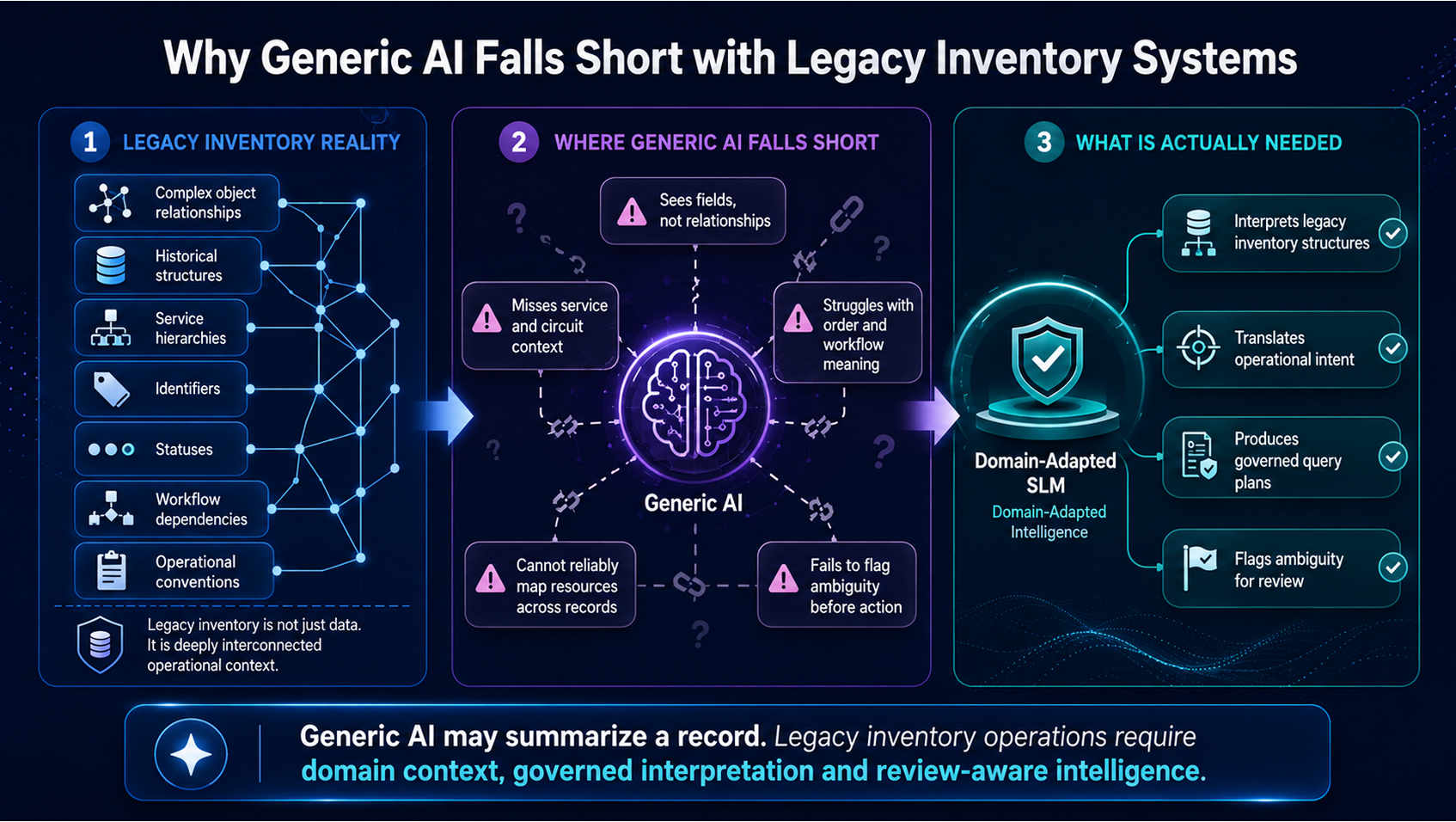
Legacy inventory systems are not ordinary datasets. They contain complex object relationships, historical structures, service hierarchies, identifiers, statuses, workflow dependencies and operational conventions that require domain context.
A general model may explain a field or summarize an export, but it may not reliably understand how records relate to services, circuits, orders, network resources and operational workflows.
 Why Generic AI Falls Short with Legacy Inventory Systems
A domain-adapted SLM is built to interpret legacy inventory structures, translate operational intent, produce governed query plans and flag ambiguity before downstream action.
What the Legacy Inventory SLM Understands
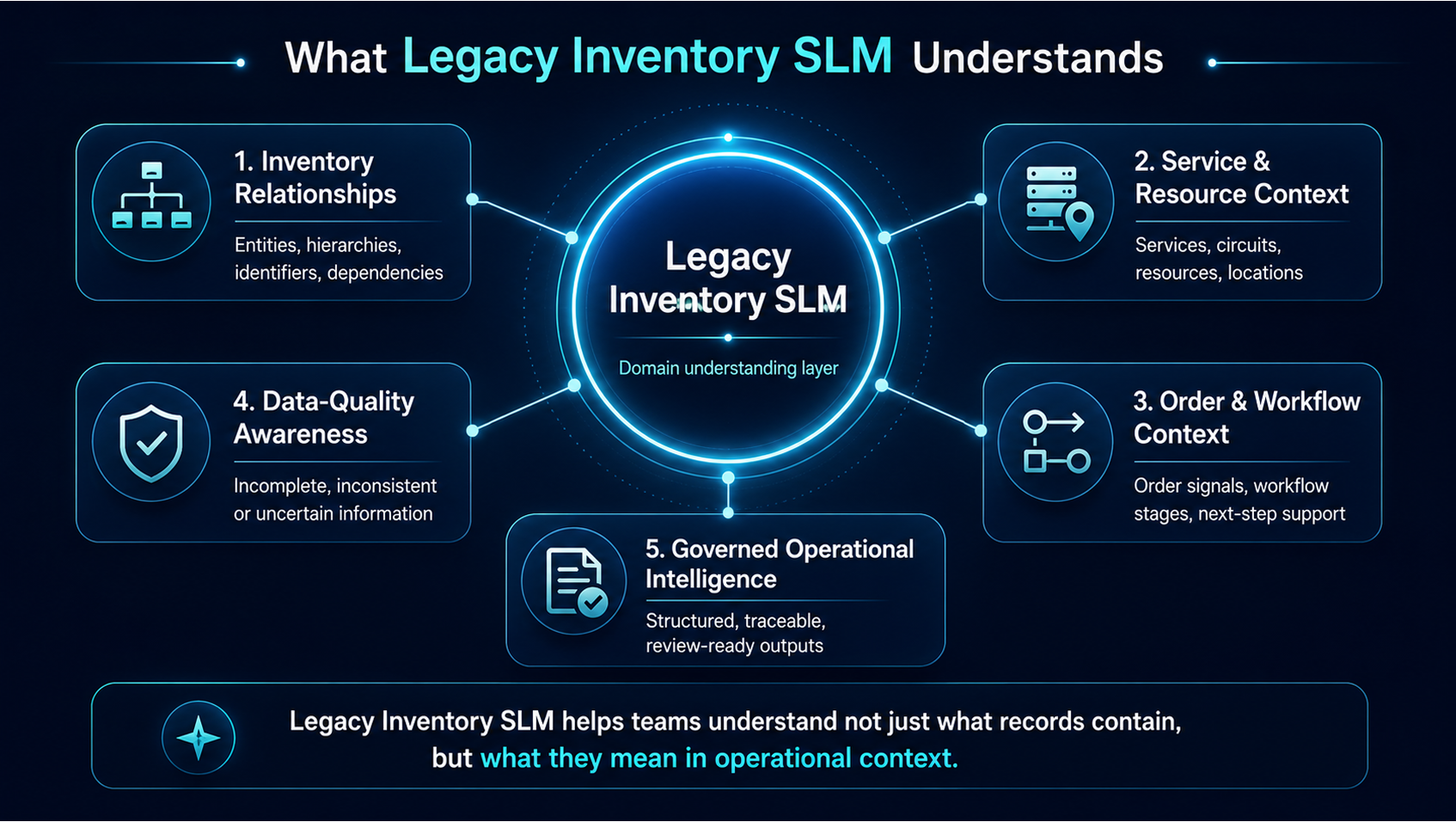
Legacy Inventory SLM is designed to understand the complex language, relationships and operational context found within legacy telecom inventory environments.
Rather than viewing inventory records in isolation, it interprets how services, resources, locations, orders and operational dependencies connect. This enables teams to obtain clearer, more relevant and review-ready intelligence from fragmented legacy information.
 What the Legacy Inventory SLM Understands
Inventory relationships
Interprets inventory entities, identifiers, hierarchies and dependencies to provide a connected view of operational data.
Service and resource context
Understands the relationship between services, circuits, network resources, equipment and locations, helping users see the broader context behind an inventory record or exception.
Order and workflow context
Connects inventory information with order activity and workflow status to support faster investigation, issue identification and operational decision-making.
Data-quality awareness
Identifies information that may be incomplete, inconsistent, outdated or uncertain so that potentially unreliable results can be reviewed before use.
Governed operational intelligence
Produces structured, traceable and review-aware intelligence that can support inventory lookup, order investigation, exception handling, reporting and existing operational workflows.
Legacy Inventory SLM helps teams understand not only what legacy inventory records contain, but what they mean within the wider operational context.
From Understanding to Governed Operational System Action
Legacy inventory intelligence is useful only when it can be trusted, traced and controlled. Legacy Inventory SLM does not bypass operational system governance or act as an independent system of record. It interprets legacy inventory context and prepares structured intelligence for controlled downstream use.
The SLM can identify relevant entities, relationships, service context, query intent, data-quality issues and likely next steps. But execution remains governed by approved query services, access permissions, validation rules, source-record references and human review where required.
This ensures that legacy inventory intelligence can support faster lookup, order investigation, fallout triage and workflow automation without compromising control over sensitive operational system data, operational actions or system-of-record authority.
What the SLM Produces
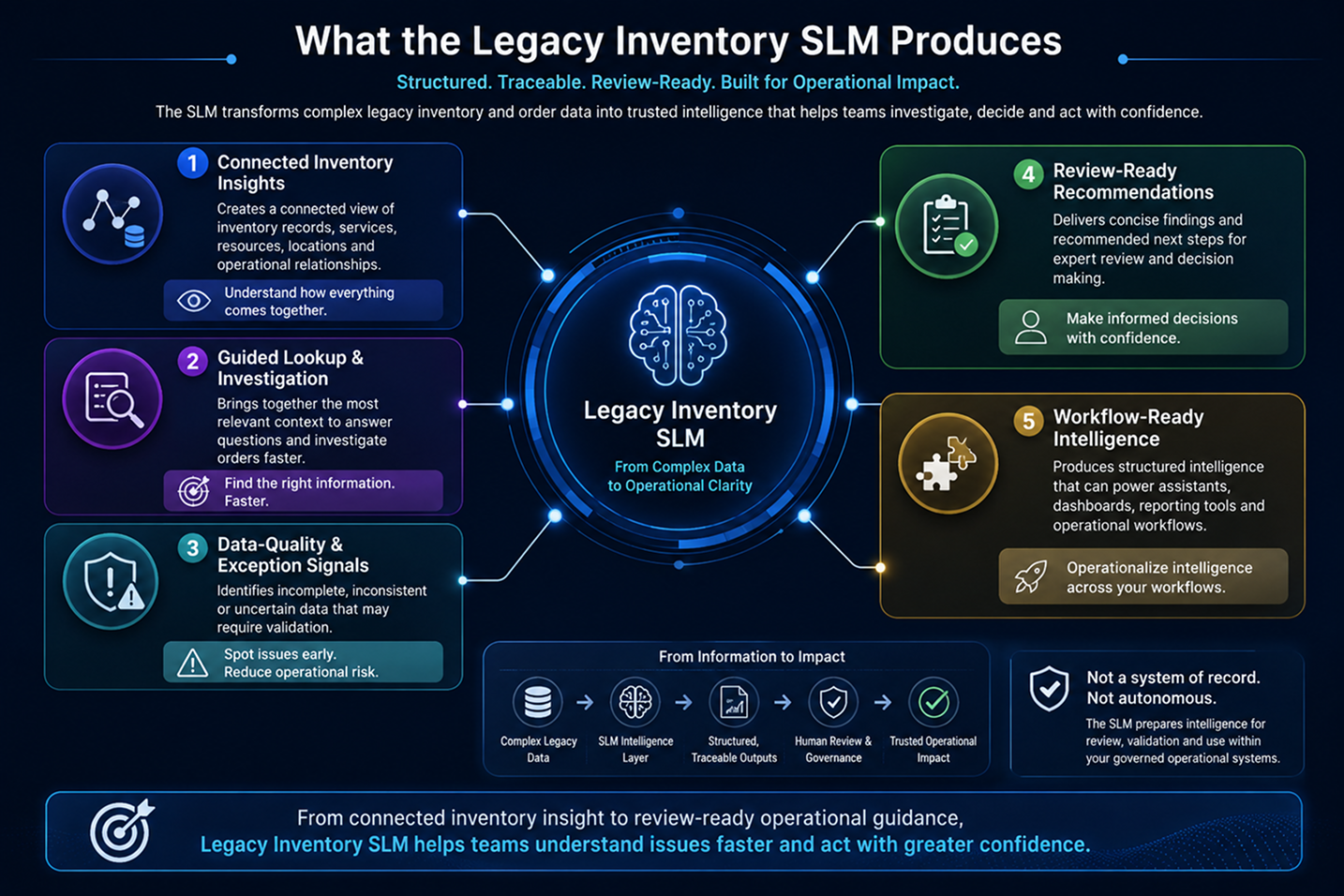
Legacy Inventory SLM transforms complex inventory and order information into structured, traceable and review-ready operational intelligence.
Rather than generating generic answers, it provides relevant insights that help teams understand inventory context, investigate operational issues, identify exceptions and make informed decisions.
 What the SLM Produces
Connected Inventory Insights
Provides a clearer view of how inventory records, services, resources, locations and related operational information connect.
Guided Lookup and Investigation
Supports faster inventory lookup and order investigation by bringing together the most relevant context for the user’s question or operational need.
Data-Quality and Exception Signals
Highlights incomplete, inconsistent or uncertain information that may require validation before it is used.
Review-Ready Recommendations
Presents concise findings and suggested next steps for expert review, helping teams make decisions while retaining appropriate oversight.
Workflow-Ready Intelligence
Delivers structured information that can support assistants, dashboards, reporting tools and existing operational workflows.
The SLM does not replace authoritative systems or independently execute operational changes. It helps teams move from fragmented legacy information to clearer, governed and actionable intelligence.
From connected inventory insight to review-ready operational guidance, Legacy Inventory SLM helps teams understand issues faster and act with greater confidence.
Adaptable to Client-Specific Legacy Environments
Every legacy inventory environment has its own data structures, terminology, workflows and governance requirements.
Legacy Inventory SLM is designed to adapt to these variations while retaining a common foundation of telecom inventory intelligence. This allows the capability to support different operators, business units and operational environments without requiring an entirely separate solution for each implementation.
Data and inventory context
Adapts to client-specific inventory structures, relationships and operating conventions.
Business terminology
Understands local identifiers, naming standards and operational language used across teams.
Workflow context
Aligns with the way each organization investigates orders, manages exceptions and handles operational activities.
Governance requirements
Supports client-specific access controls, review processes and information-handling expectations.
A common domain-intelligence foundation, adapted to the way each client’s legacy environment is structured, governed and operated.
Built to Fit Existing Workflows
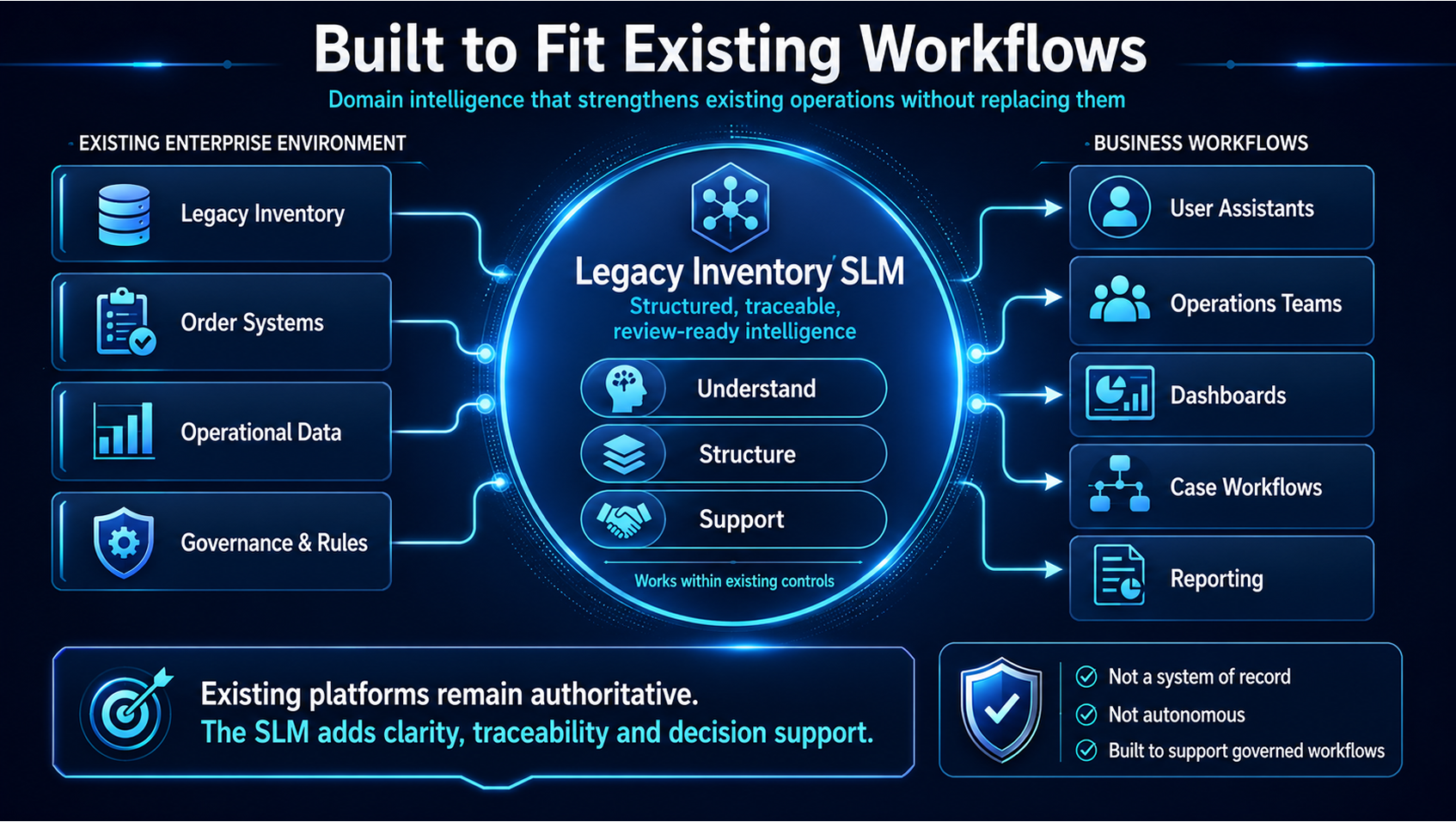
Legacy Inventory SLM is designed to work within the tools, systems and operational processes that telecom teams already use.
It brings domain-aware intelligence into existing inventory and order workflows, helping teams find relevant context, investigate issues, identify exceptions and make more consistent operational decisions.
 Built to Fit Existing Workflows
The capability can support user-facing assistants, dashboards, case workflows, reporting tools and other operational applications—bringing intelligence to the environments where teams already work.
Existing platforms continue to control records, permissions, approvals and operational actions. The SLM provides structured, traceable and review-ready intelligence without disrupting established governance or system authority.
Modernize legacy inventory operations without replacing the systems and workflows that already run them.
Measurable Value: Model Quality and Business Impact
The value of Legacy Inventory SLM should be measured at two levels: first, whether it produces reliable, structured and source-backed intelligence for legacy inventory workflows; second, whether that intelligence improves how telecom teams retrieve inventory context, investigate orders, triage fallout, manage exceptions and support downstream operations when embedded into governed workflows with validation, review and audit controls.
Model quality proves the SLM can understand the legacy inventory domain. Business impact proves that understanding can reduce operational friction without weakening system-of-record control.
SLM Quality Indicators
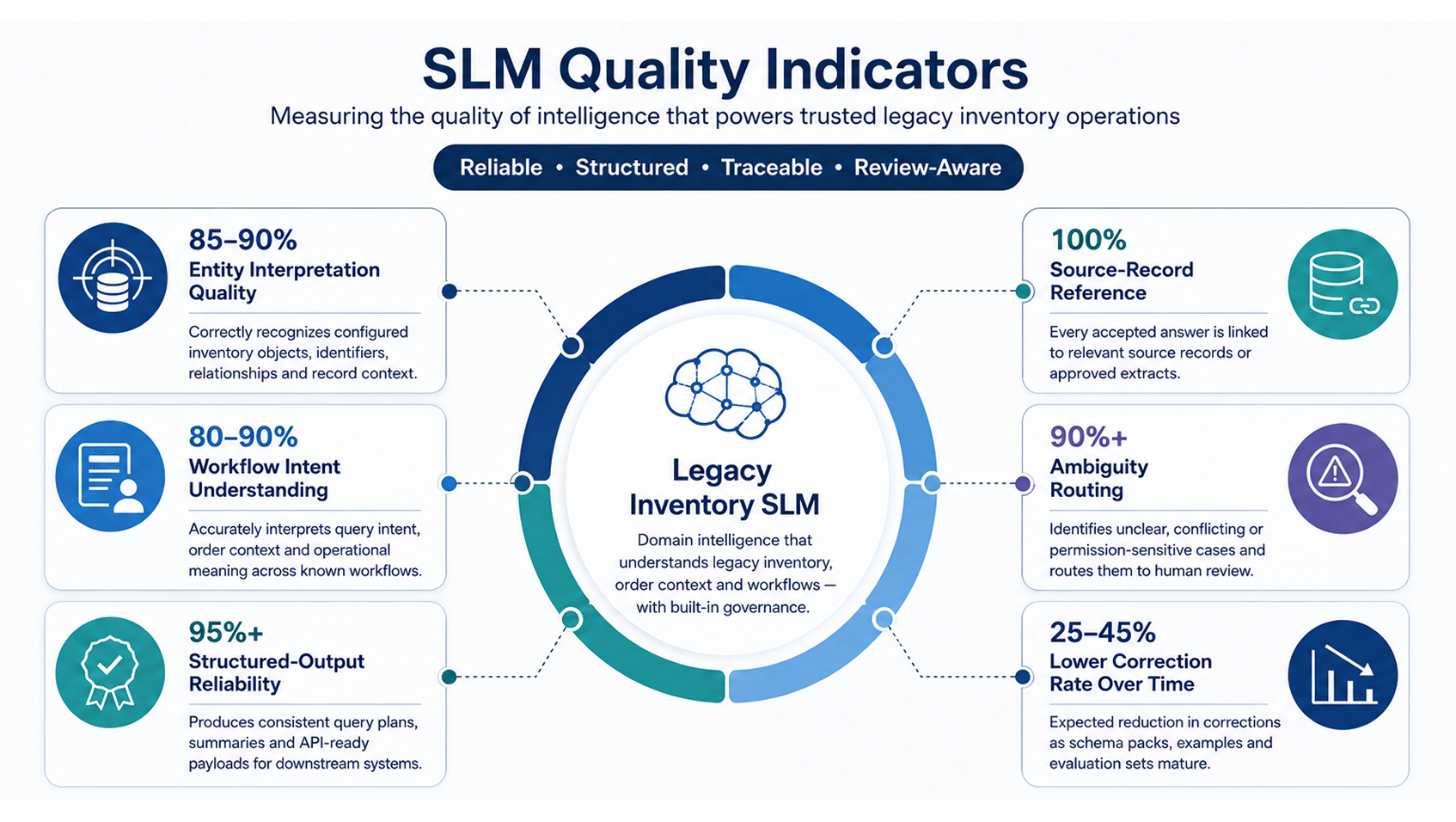
SLM quality indicators measure whether Legacy Inventory SLM is producing intelligence that can be trusted in real telecom operations. The focus is not only on whether the model gives an answer, but whether it correctly interprets legacy inventory entities, understands order and workflow intent, produces consistent structured outputs, links responses back to approved source records, and routes ambiguous or permission-sensitive cases for review. These indicators help prove that the SLM is domain-aware, traceable, governed and ready to support downstream operational system workflows without weakening expert oversight or system-of-record control.
 SLM Quality Indicators
Operational Outcomes Enabled by the SLM
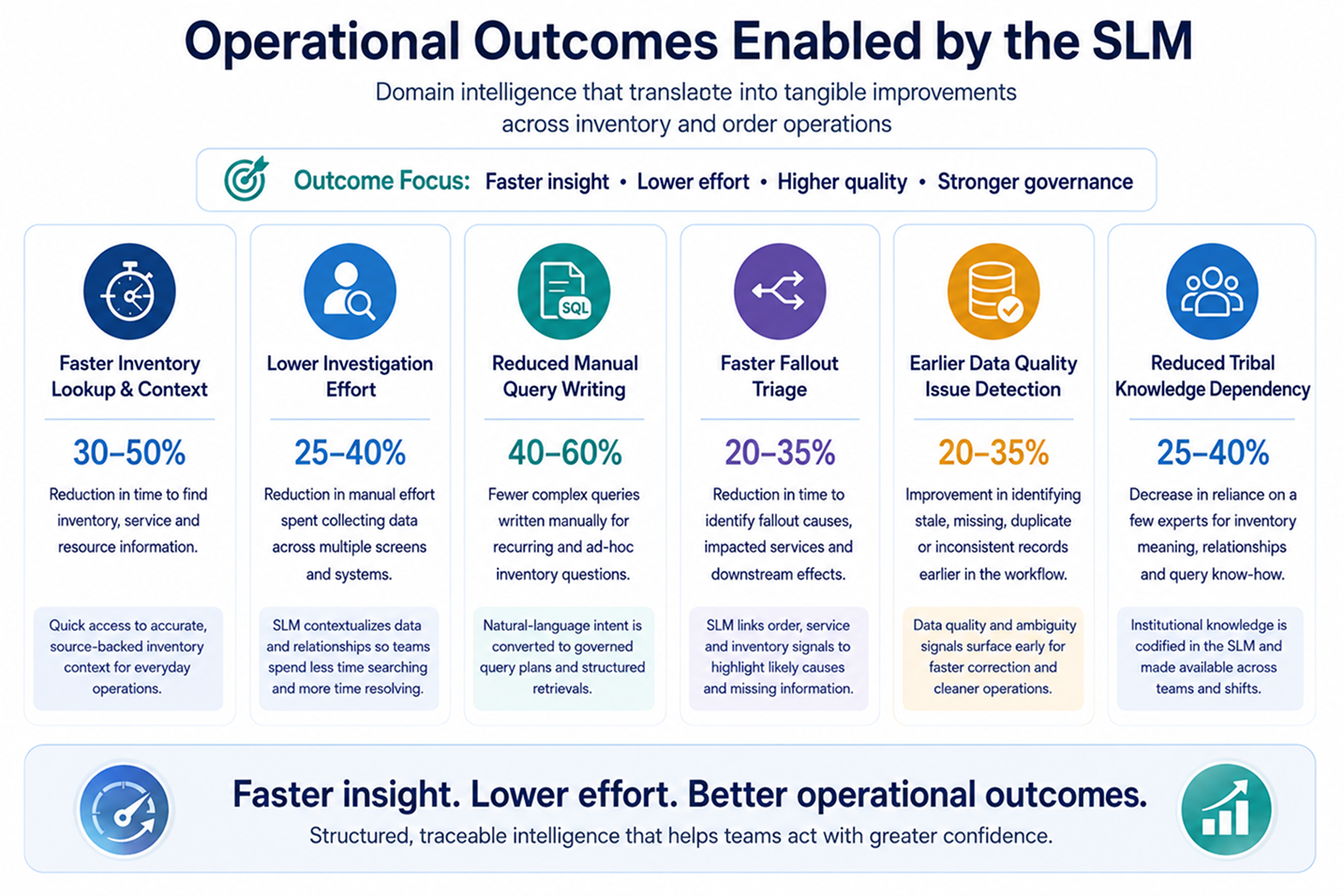
Operational outcomes measure how Legacy Inventory SLM improves day-to-day telecom inventory and order operations when its intelligence is embedded into governed workflows. The focus is not only on model accuracy, but on whether domain-aware outputs help teams retrieve inventory context faster, reduce manual investigation effort, write fewer complex queries, triage fallout more consistently, identify data-quality issues earlier and reduce dependency on tribal knowledge. These outcomes should always be validated against each client’s Legacy inventory configuration, data quality, integration scope and operating process, but they show the practical business value of turning legacy inventory understanding into structured, traceable and review-ready workflow support.
 Operational Outcomes Enabled by the SLM
Governed by Design
Legacy Inventory SLM is designed for enterprise environments where accuracy, accountability and human oversight are essential.
It delivers structured, traceable and review-aware intelligence while existing platforms, permissions and operational processes remain authoritative.
Traceable intelligence
Outputs can be connected to approved source information, enabling users to understand and verify the basis of the result.
Access-aware operation
The capability works within established information-access boundaries and organizational controls.
Review when it matters
Unclear, sensitive or higher-impact situations can be presented for expert review rather than treated as final.
Controlled operational use
Insights are designed to support informed decisions and governed workflows without independently executing changes.
Trusted intelligence that helps teams move faster—without giving up control, accountability or expert oversight.
Flexible Deployment, Built Around Your Environment
Legacy Inventory SLM can be introduced in a way that aligns with each organization’s technology landscape, security requirements and operational priorities.
It is designed to complement existing systems and workflows, allowing organizations to adopt domain intelligence without undertaking disruptive platform replacement.
User-facing experience
The capability can support an intuitive assistant experience that helps users access inventory context, investigate issues and obtain guided operational insights.
Embedded operational intelligence
Domain intelligence can be brought into the applications, workflows, dashboards and operational tools that teams already use.
Client-controlled deployment
Deployment can be aligned with enterprise requirements for security, privacy, access control, infrastructure and data governance.
Phased adoption
Organizations can begin with a focused use case, validate business value and progressively expand the capability as operational confidence and readiness grow.
Existing platforms remain authoritative for records, permissions, approvals and operational actions.
Start with a focused need. Demonstrate value. Expand with confidence.
Why Ligaments.ai
Ligaments.ai brings a domain-first approach to AI for complex operational environments. Legacy Inventory SLM is not built as a generic database Q&A layer. It is designed to understand legacy telecom inventory structures, order context, workflow dependencies and governed operational system operations.
The value is not only in generating answers. The value is in producing structured, traceable and review-ready intelligence that can support real telecom workflows without replacing existing systems, bypassing controls or weakening expert oversight.
Domain-adapted for legacy telecom inventory
Ligaments.ai focuses on domain-specific intelligence rather than generic AI responses. The SLM is designed to understand legacy inventory objects, identifiers, service relationships, circuit context, resource dependencies, order signals and operational terminology.
Built for structured operational outputs
The SLM is designed to produce outputs that can be used by teams and systems: query plans, lookup summaries, relationship maps, exception flags, investigation packs, review briefs and API-ready payloads.
This makes the capability useful beyond chat and supports integration into assistants, dashboards, workflow queues and operational system processes.
Designed around governance and control
Ligaments.ai positions the SLM as an intelligence layer, not as an uncontrolled automation engine or system of record. Source-record traceability, access awareness, validation rules, ambiguity routing and human review are central to the operating model.
Adaptable to client-specific environments
Telecom operators rarely have identical legacy inventory environments. The SLM can be configured using schema packs, object taxonomies, data dictionaries, workflow examples, access policies and output schemas so it can adapt to different legacy inventory implementations and operating models.
Integration-ready for existing operational system workflows
The SLM is designed to fit into existing technology investments. It can support the Legacy Inventory Assistant, integrate through APIs, provide structured outputs to dashboards, support order operations, and feed workflow or case-management processes.
Built to reduce operational friction
The goal is to help teams find inventory context faster, investigate orders more consistently, triage fallout with better evidence, identify data-quality issues earlier and reduce dependency on tribal knowledge.
Clear boundary of responsibility
Ligaments.ai does not position the SLM as a replacement for legacy inventory, operational systems, order management systems or expert users. Existing systems remain authoritative; the SLM adds domain intelligence that makes workflows faster, more traceable and easier to act on.
Ligaments.ai helps telecom teams bring domain-tuned AI into legacy inventory operations without forcing system replacement, compromising governance or losing control over critical operational system processes.
Bring Domain-Tuned AI into Legacy Inventory Operations
Use Legacy Inventory SLM to support legacy data interpretation, query planning, inventory lookup, order investigation and governed workflow automation.
Talk to Ligaments.ai to explore how domain-adapted SLM intelligence can bridge Legacy Inventory environments with modern AI-driven operations.