

The SLM converts prepared business and transaction inputs into structured, explainable and review-aware signals that can support governed GST filing workflows. It does not replace tax professionals, statutory filing responsibility, enterprise systems of record or final reviewer judgment.
Domain-Tuned Intelligence, Built for Controlled Use
GST Filing SLM is built for controlled compliance preparation, not uncontrolled tax automation. It interprets invoices, registers, ledgers, ERP extracts, entity records and transaction context, then produces structured intelligence that can be validated by rules, reviewed by finance and tax users, and traced back to approved source records.
The SLM acts as the domain intelligence layer within a governed operating model. Configured rules, deterministic validation services, reviewer approvals, access controls and audit logs remain responsible for deciding whether outputs are accepted, corrected, escalated or included in a filing-preparation pack.
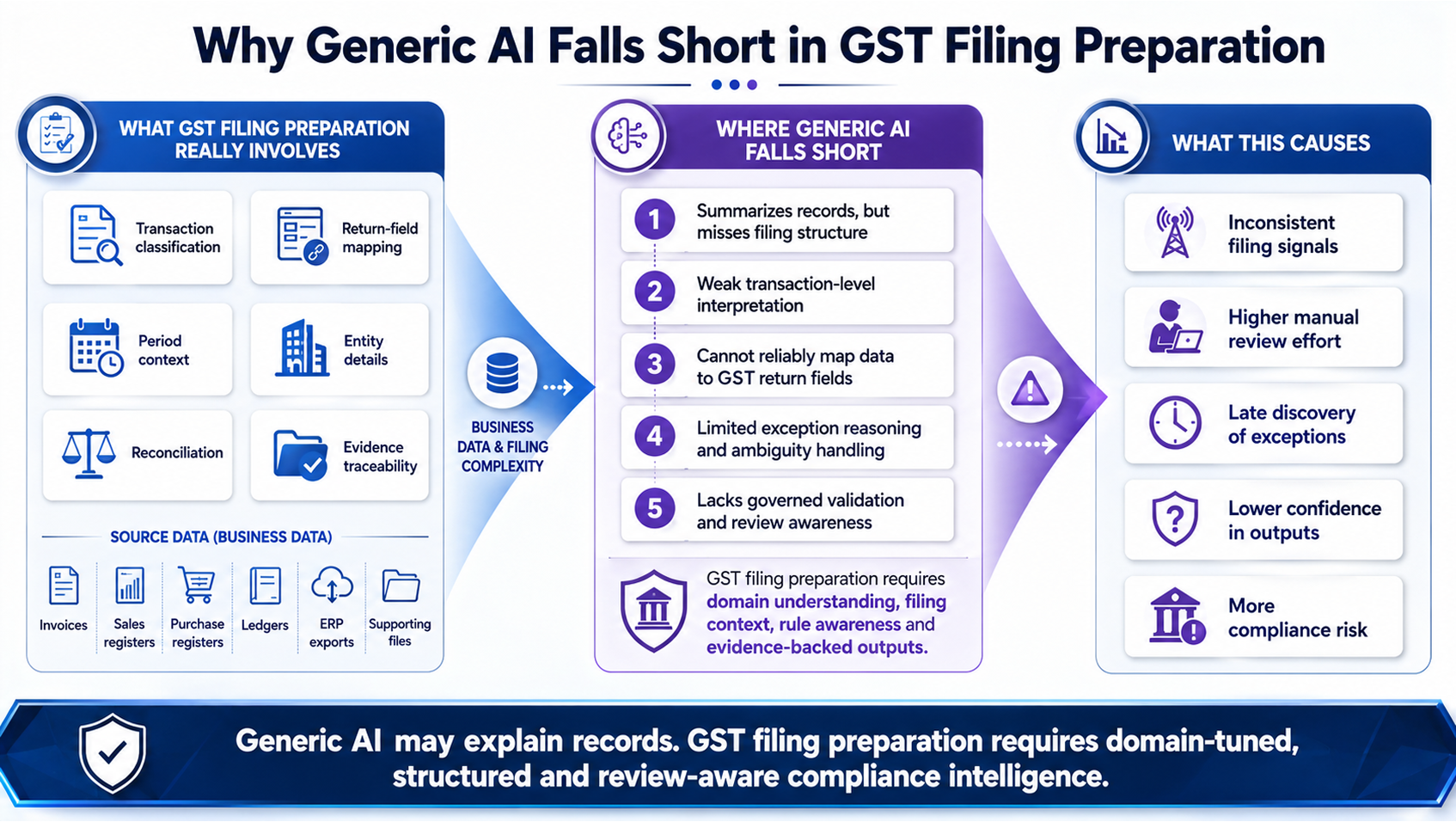
Why Generic AI Falls Short in GST Filing Preparation
GST filing preparation is not simply document summarization. It requires transaction classification, return-field mapping, tax-period context, entity awareness, reconciliation, exception explanation, source-record evidence and reviewer-controlled decisioning.
Business data may sit across sales invoices, purchase invoices, tax registers, ledgers, ERP exports, entity master records and supporting files. A general model may summarize records or answer questions, but it may not reliably produce filing-ready structured signals, identify review-sensitive exceptions or preserve the evidence trail needed for tax and audit workflows.
A GST-tuned SLM is designed to understand transaction meaning, map data to GST preparation structures, reason over exception patterns and route uncertain cases for finance or tax review instead of forcing a premature filing-ready output.
 Why Generic AI Falls Short in GST Filing Preparation
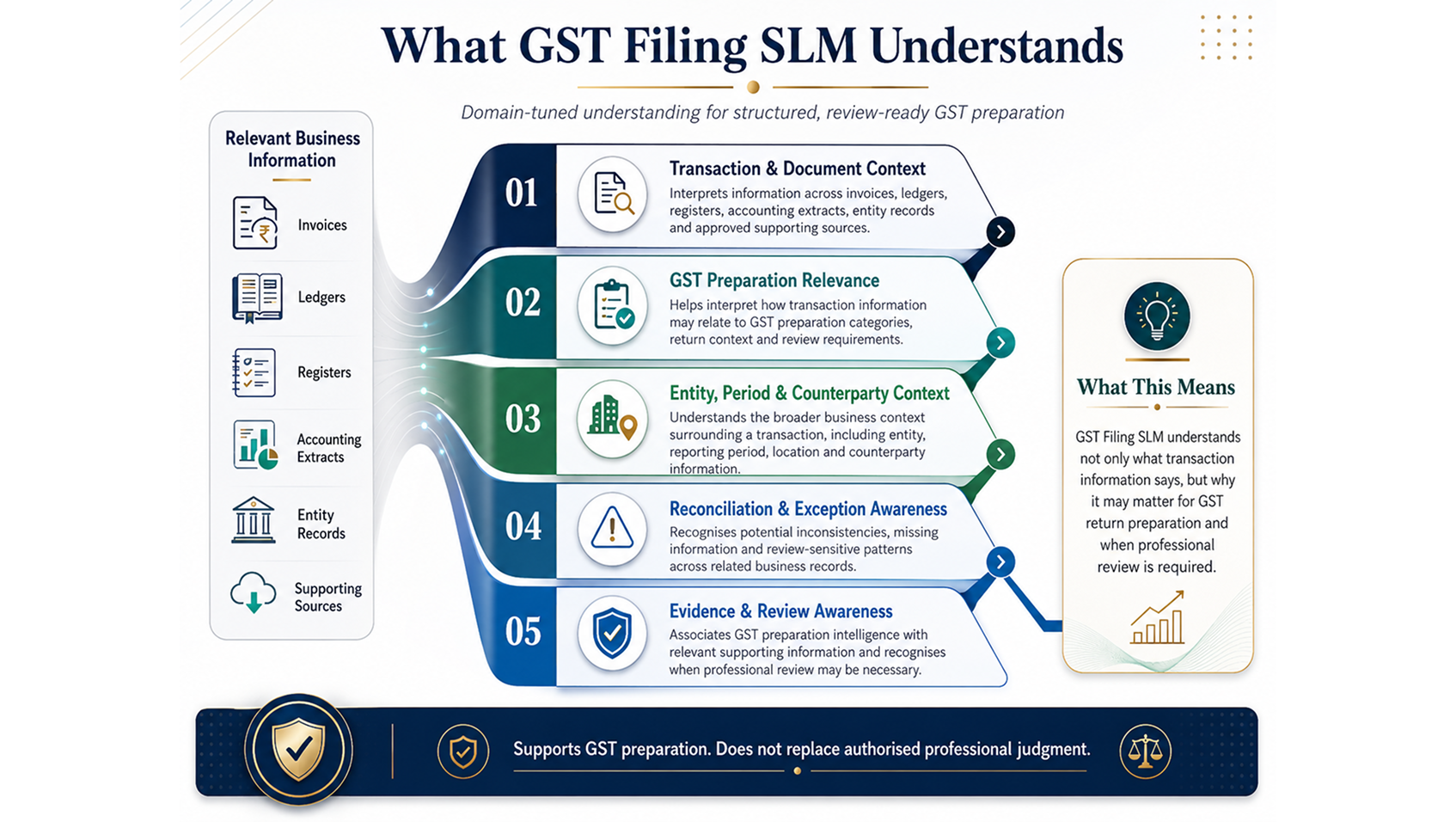
What GST Filing SLM Understands
GST Filing SLM is tuned to interpret the transaction language, business context and review considerations involved in GST return preparation.
Rather than treating invoices, ledgers, registers and accounting extracts as isolated records, it helps finance and tax teams understand how related information may affect GST preparation, validation and professional review.
 What GST Filing SLM Understands
GST Filing SLM brings together transaction context, GST preparation relevance, entity and period awareness, exception recognition and supporting-evidence awareness to produce more structured and review-ready intelligence.
It supports GST preparation but does not independently determine tax treatment or replace authorised professional judgment.
GST Filing SLM understands not only what transaction information says, but why it may matter for GST return preparation and when professional review is required.
From GST Intelligence to Governed Use
GST Filing SLM helps interpret prepared business information and convert it into structured, review-aware GST preparation intelligence.
These outputs can support validation and professional review, but they are not final tax-treatment or filing decisions. Authorised finance and tax professionals, approved organisational controls and existing enterprise systems determine how the information is verified and used.
The SLM provides GST-focused intelligence. Governed processes and professional judgment determine the final action.
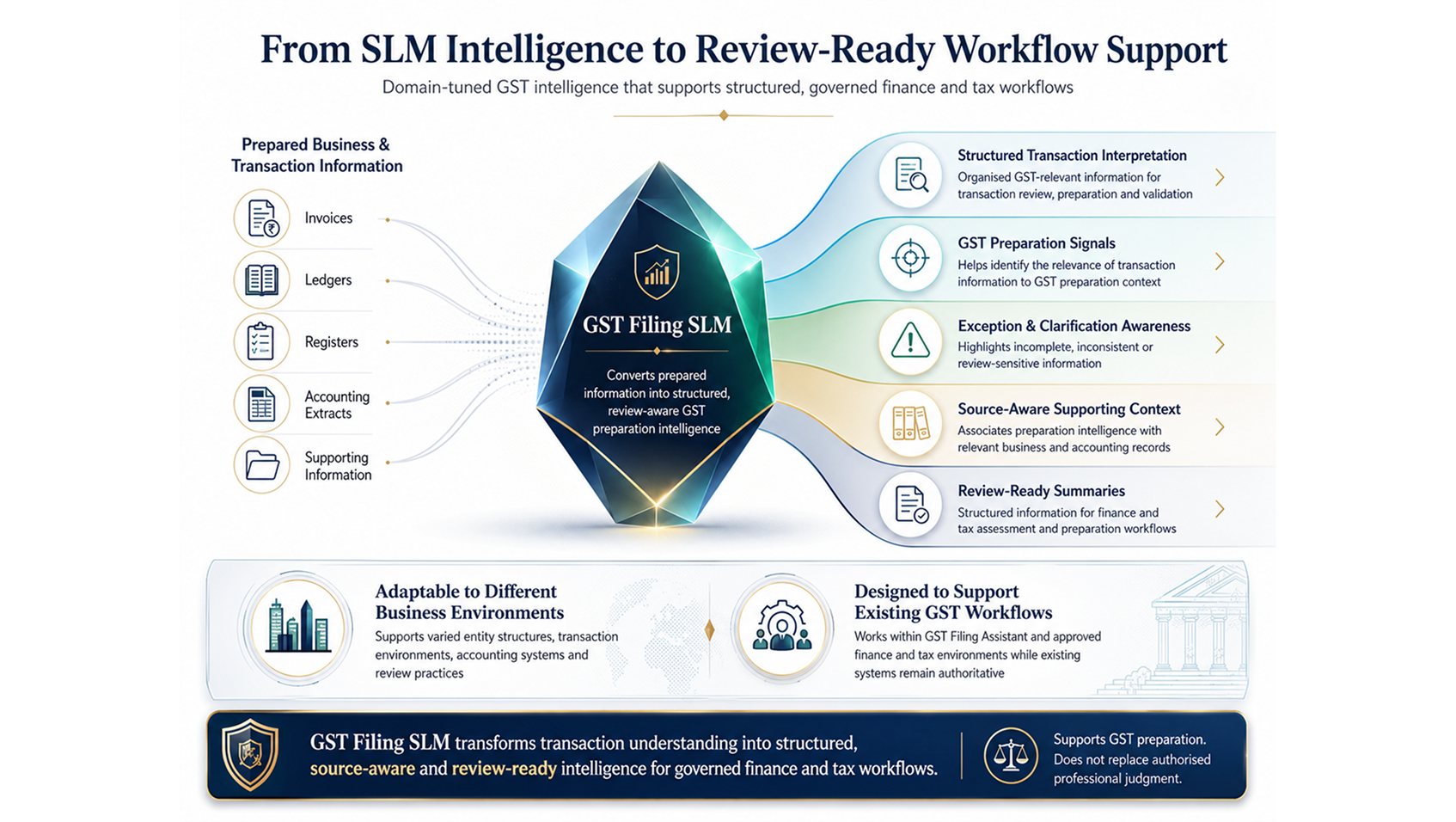
From SLM Intelligence to Review-Ready Workflow Support
GST Filing SLM converts prepared business and transaction information into structured, review-aware GST preparation intelligence.
Rather than producing free-form answers alone, it helps finance and tax teams obtain more consistent transaction interpretation, clearer exception visibility and better supporting context for governed GST preparation workflows.
 From SLM Intelligence to Review-Ready Workflow Support
GST Filing SLM can support structured transaction interpretation, GST preparation signals, exception awareness, source-backed context and review-ready summaries.
It can be aligned with different business environments and work within GST Filing Assistant or other approved finance and tax workflows while existing enterprise systems remain authoritative.
Authorised finance and tax professionals retain responsibility for validation, tax treatment, approval, statutory compliance and submission.
GST Filing SLM transforms transaction understanding into structured, source-aware and review-ready intelligence for governed finance and tax workflows.
Measurable Value: Model Quality and Business Impact
GST Filing SLM should be measured at two levels: first, whether the model produces reliable, structured, source-backed and review-aware compliance intelligence for GST return-preparation workflows; second, whether that intelligence improves return-preparation speed, validation quality, exception handling, reviewer productivity and audit readiness when embedded into governed workflows with configured rules, approvals and audit controls.
Model quality proves that the SLM can interpret GST return-preparation context correctly. Business impact proves that this intelligence can reduce manual effort, improve review control and lower operational friction without weakening finance oversight, tax accountability or system-of-record authority.
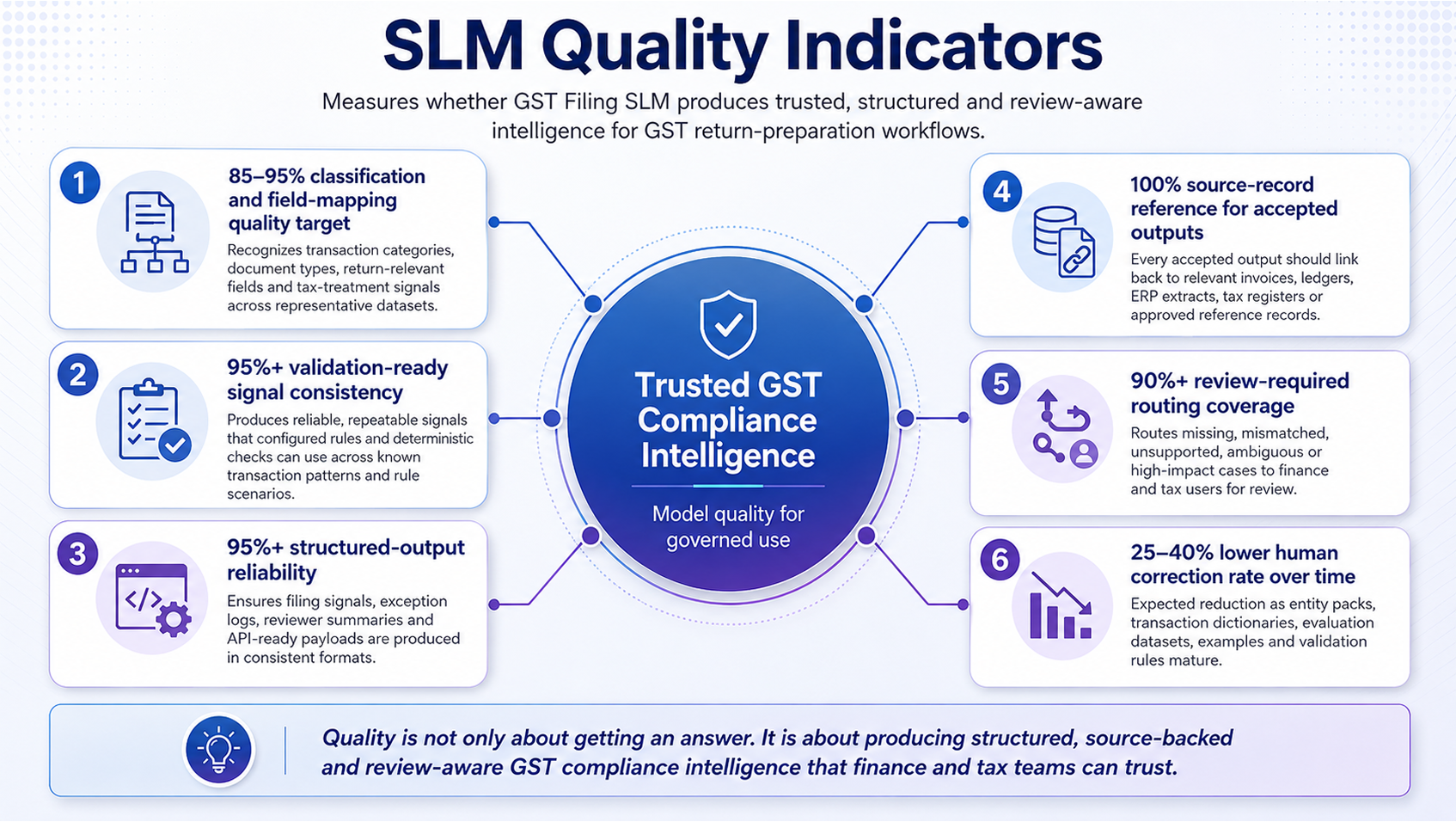
SLM Quality Indicators
SLM quality indicators measure whether GST Filing SLM produces intelligence that can be trusted in real GST return-preparation workflows. The focus is not only whether the model gives an answer, but whether it correctly classifies transactions, maps filing-relevant fields, produces consistent structured outputs, links outputs to approved source records and routes ambiguous, unsupported or high-impact cases for review.
 SLM Quality Indicators
Operational Outcomes Enabled by the SLM
Operational outcomes measure how GST Filing SLM improves day-to-day GST return preparation when its intelligence is embedded into governed workflows. The focus is whether structured, source-backed and review-aware outputs help finance and tax teams reduce manual preparation effort, validate data faster, triage exceptions earlier, improve filing-readiness visibility and prepare stronger audit evidence.
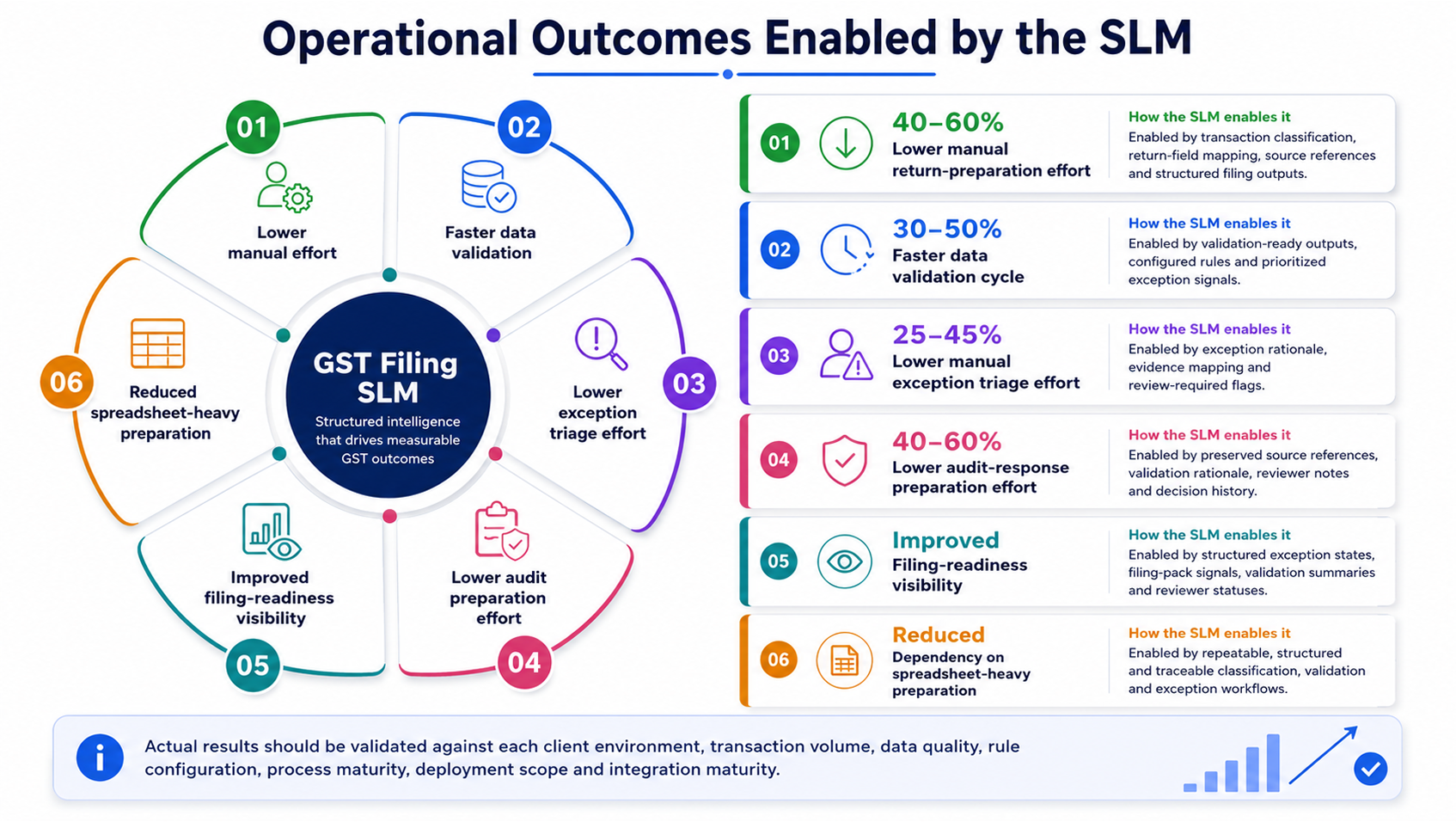 Operational Outcomes Enabled by the SLM
Governed and Review-Aware by Design
GST Filing SLM is designed for controlled use in finance and tax environments where accuracy, accountability and professional oversight are essential.
It supports GST return preparation by providing structured, source-aware and review-ready intelligence. It does not independently determine tax treatment, approve returns or perform statutory filing.
Professional oversight remains central
Finance and tax professionals retain responsibility for interpretation, corrections, approval, statutory compliance and submission.
Review when clarification is required
The model helps recognise incomplete, inconsistent or review-sensitive information rather than presenting uncertain information as a final conclusion.
Source-aware preparation
GST preparation intelligence can be associated with relevant approved business records, helping users review and understand the information supporting an output.
Responsible information handling
The SLM is designed to operate within the organisation’s established requirements for data access, security, privacy and governance.
Existing authority remains intact
ERP, accounting, tax and filing systems continue to remain authoritative for official records and statutory processes.
Accountable use
The SLM strengthens preparation and review while professional judgment, organisational controls and statutory responsibility remain fully in place.
Trusted GST preparation intelligence that strengthens professional review without replacing tax judgment or statutory accountability.
Flexible Deployment and Governed Adoption
GST Filing SLM can be introduced in a manner aligned with each organisation’s GST operating model, information environment, security requirements and governance expectations.
Organisations can begin with a focused GST preparation requirement, evaluate the quality and usefulness of the model’s intelligence, and expand its use progressively as confidence, data readiness and operational alignment develop.
Focused initial adoption
The SLM can initially support a defined transaction interpretation, preparation or review requirement before being extended to broader GST use cases.
Professionally supervised evaluation
Finance and tax users remain involved in assessing model outputs, reviewing their relevance and determining how the intelligence should be used within established processes.
Secure and client-aligned deployment
Deployment can be aligned with organisational requirements for data protection, access control, infrastructure, privacy and information governance.
Adaptable to existing environments
GST Filing SLM can operate within GST Filing Assistant or support approved finance and tax workflows while working alongside established ERP, accounting and tax systems.
Progressive expansion
Usage can expand gradually as model quality, business value, governance readiness and user confidence are demonstrated.
Existing enterprise systems remain authoritative for official records and statutory processes. Authorised finance and tax professionals retain responsibility for validation, tax treatment, corrections, approval, compliance and submission.
Start with a focused GST requirement. Validate quality under professional oversight. Expand through controlled adoption.
Why GST Filing SLM by Ligaments.ai
Ligaments.ai brings a domain-first and governed approach to AI for complex finance, tax and compliance workflows.
GST Filing SLM is designed specifically for GST return preparation—not as a generic chatbot or autonomous filing engine. It helps finance and tax teams interpret transaction information more consistently, identify review-sensitive areas and generate structured intelligence for governed preparation workflows.
Purpose-built for GST preparation
The model is tuned around the transaction context, business information and review considerations involved in GST return preparation.
Beyond generic document intelligence
GST Filing SLM is designed to understand how related transaction and business information may affect preparation, validation and professional review rather than simply summarising individual documents.
Structured and review-aware
It provides more organised, source-aware and review-ready intelligence that can support finance and tax assessment.
Professionally governed
The SLM operates within a controlled environment where authorised professionals retain responsibility for interpretation, validation, corrections, approvals, statutory compliance and submission.
Adaptable to different business environments
The model can support varied entity structures, transaction environments, accounting systems and GST review practices.
Designed to strengthen existing workflows
GST Filing SLM can operate within GST Filing Assistant and other approved finance and tax environments while established ERP, accounting, tax and filing systems remain authoritative.
Focused on operational value
Ligaments.ai focuses not only on model performance, but also on whether the intelligence can improve preparation consistency, exception visibility, review efficiency and filing readiness.
Ligaments.ai combines GST-focused intelligence, governed model design and practical workflow alignment to help finance and tax teams prepare with greater clarity, consistency and control.
Bring Domain-Tuned Intelligence into GST Return Preparation
GST Filing SLM helps finance and tax teams interpret transaction information more consistently, identify review-sensitive areas earlier and prepare more structured, review-ready GST intelligence.
Strengthen preparation quality, improve review efficiency and support greater filing readiness while authorised professionals retain responsibility for tax treatment, approval, statutory compliance and submission.
Talk to Ligaments.ai to explore how GST-focused, fine-tuned intelligence can support your finance and tax operations.