Client Overview
A global enterprise with distributed development teams delivering large-scale digital platforms across multiple business units. The client operated complex codebases, multiple technology stacks, and lengthy development cycles.
Productivity dropped due to repetitive coding, limited test coverage, inconsistent documentation, and fragmented DevOps practices.
Leadership sought an AI-driven platform that could accelerate delivery speed, improve engineering quality, and standardize development workflows across teams.
The Challenge
The software engineering organization faced mounting inefficiencies across the entire SDLC. Developers spent excessive time on boilerplate coding, test creation, containerization, and documentation—tasks that slowed delivery and introduced quality inconsistencies. As codebases grew, so did technical debt, maintenance overhead, and onboarding complexity.
Key challenges included:
- Repetitive coding work consuming 40-60% of developer time
- Manual test creation leading to poor coverage and regression risk
- Inconsistent Dockerization and container configurations across teams
- Outdated or missing documentation, impacting onboarding and knowledge transfer
- Architectural inconsistencies due to varying developer skill levels
- Fragmented workflows requiring developers to switch between tools, IDEs, and environments
- Increasing delivery pressure with limited resources
These challenges collectively increased cycle time, reduced code quality, and slowed innovation across development squads.
Our AI Solution
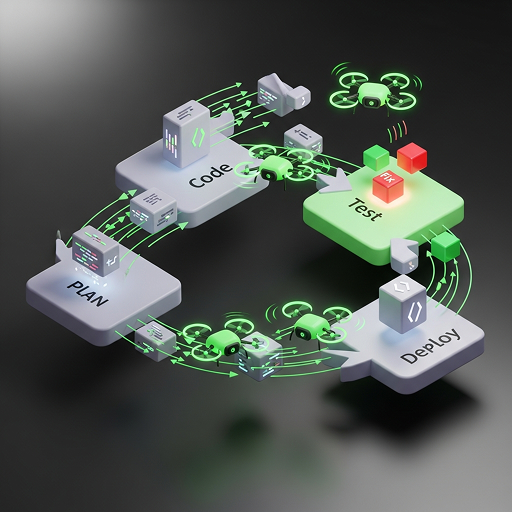
We deployed an AI-Powered SDLC Automation Platform—a unified suite of intelligent agents that automates code generation, testing, containerization, and documentation, delivering end-to-end lifecycle acceleration.
1. Context-Aware Code Generation
AI agents generate production-ready code from natural language requirements, ensuring consistency with existing architectural patterns and coding standards.
- Automatic project scaffolding and dependency setup
- Multi-language support (backend, frontend, DB, APIs)
- Intelligent refactoring and modernization of legacy code
- Code suggestions aligned with team conventions and security patterns
2. Comprehensive Automated Test Suite Generation
AI generates complete unit, integration, and end-to-end test suites using static code analysis and behavior inference.
- Test creation for positive, negative, and boundary cases
- Automatic mocking, fixtures, and regression coverage
- Tests updated automatically as code evolves
- Multi-framework support (Jest, PyTest, JUnit, etc.)
3. Automated Dockerization & Container Optimization
The platform creates optimized container configurations and orchestration artifacts without requiring deep DevOps expertise.
- Multi-stage Dockerfile generation
- Dependency scanning and vulnerability removal
- Kubernetes manifests & docker-compose auto-generation
- Environment-aware builds ensuring dev-prod parity
4. Intelligent Documentation Generation & Maintenance
Documentation agents keep project documentation continuously in sync with the codebase.
- Auto-generated API docs (OpenAPI/Swagger)
- Architecture diagrams & dependency maps
- Inline code comments and developer guides
- Versioned documentation updated with each commit
5. Seamless Workflow & CI/CD Integration
- IDE plugins for in-editor AI assistance
- CI/CD hooks for automated testing and documentation updates
- API endpoints for custom automation pipelines
- Built-in quality, performance, and security scanning
Impact & Key Results
The platform transformed the client's software development lifecycle, enabling engineering teams to deliver faster, improve quality, and reduce manual effort across all SDLC stages. Tasks that once consumed days were completed in minutes, allowing developers to focus on business logic and innovation rather than mechanical work.
Key results included:
- 50-70% reduction in development time through automated code generation and scaffolding
- 85-95% test coverage, improving reliability and cutting regression failures
- 40-60% reduction in container image size with optimized multi-stage builds
- Significant improvement in deployment stability due to standardized orchestration configs
- 90%+ documentation coverage, continuously synchronized with code changes
- Faster onboarding (60-70% improvement) thanks to consistent code patterns and complete documentation
- 50-60% reduction in production defects through comprehensive testing and best-practice enforcement
- Reduced technical debt, as legacy code modernized automatically and documentation stayed current
Overall, the engineering organization achieved higher throughput, better quality, and a more scalable development process.
Call to Action
Accelerate your software development lifecycle with AI-powered SDLC automation — Connect with us to explore the platform.