

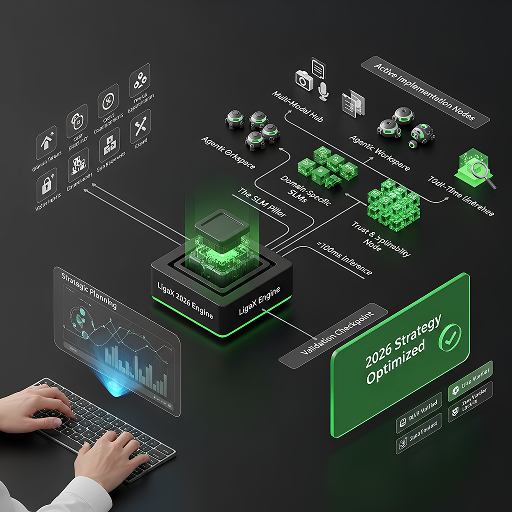
Based on current trajectories and client conversations, here's what we see coming in 2026:
1. The Rise of Multi-Modal Enterprise AI
 1. The Rise of Multi-Modal Enterprise AI
Prediction: Text-only AI will become the exception rather than the rule.
Our Focus:
- Unified RAG systems that index text, images, audio, and structured data
- Vision-language models for document understanding (diagrams, charts, handwritten notes)
- Audio processing for meeting transcription and action item extraction
- Video analysis for quality control, compliance monitoring, and training
Impact: Enterprises will unlock value from previously "dark" data—images in PDFs, whiteboards from meetings, surveillance footage, voice calls.
2. Compound AI Systems Mature
 2. Compound AI Systems Mature
Prediction: Single-model solutions will be replaced by orchestrated model ensembles.
Our Focus:
- Automatic task decomposition and routing to specialized models
- Multi-model consensus mechanisms for high-stakes decisions
- Dynamic model selection based on real-time performance and cost data
- Hybrid systems combining traditional ML, rule engines, and LLMs
Impact: Better accuracy, lower costs, more explainable decisions.
3. Agentic Workflows Go Mainstream
 3. Agentic Workflows Go Mainstream
Prediction: Agent-based automation will move from experimentation to production at scale.
Our Focus:
- Multi-agent collaboration frameworks with clear role definitions
- Sophisticated planning and replanning capabilities
- Better tool ecosystems with standardized interfaces
- Advanced safety measures and approval workflows
Impact: Complex, multi-step business processes will be automated end-to-end with human oversight at critical junctures.
4. Real-Time AI Becomes Table Stakes
 4. Real-Time AI Becomes Table Stakes
Prediction: Batch processing will give way to streaming AI pipelines.
Our Focus:
- Low-latency inference optimization (<100ms for most queries)
- Streaming data ingestion and processing
- Real-time model fine-tuning based on user interactions
- Edge AI deployment for privacy-sensitive applications
Impact: AI applications will feel instantaneous, enabling new use cases in customer service, trading, and operational monitoring.
5. Explainability and Trust Take Center Stage
 5. Explainability and Trust Take Center Stage
Prediction: Regulatory pressure and user demand will make AI explainability non-negotiable.
Our Focus:
- Comprehensive audit trails for all AI decisions
- Natural language explanations of model reasoning
- Confidence scores and uncertainty quantification
- Counterfactual analysis ("what if" scenarios)
Impact: AI systems will be deployable in regulated industries (healthcare, finance, government) with full compliance.
6. The Semantic Layer Revolution
 6. The Semantic Layer Revolution
Prediction: Organizations will build unified semantic layers that abstract complexity from end users.
Our Focus:
- Business concept modeling that bridges technical and business terminology
- Natural language to structured query translation
- Automatic schema mapping across heterogeneous systems
- Knowledge graph integration for contextual understanding
Impact: Business users will query complex data landscapes in natural language without understanding underlying technical details.
7. AI Cost Optimization Becomes Strategic
 7. AI Cost Optimization Becomes Strategic
Prediction: As AI spending grows, CFOs will demand ROI accountability.
Our Focus:
- Granular cost tracking per transaction, user, department
- Automatic cost optimization recommendations
- Caching strategies for repeated queries
- Model compression and quantization for edge deployment
Impact: AI projects will need to justify spend with clear business metrics, driving more disciplined deployment.
8. Privacy-Preserving AI Gains Adoption
 8. Privacy-Preserving AI Gains Adoption
Prediction: Data privacy concerns will drive adoption of federated learning and differential privacy.
Our Focus:
- Federated learning implementations for multi-tenant scenarios
- Differential privacy in training and inference
- Synthetic data generation for testing and development
- On-premise and private cloud deployment options
Impact: AI will be deployable in privacy-sensitive contexts (healthcare, HR, personal finance) without compromising data security.
9. The Composable AI Marketplace Emerges
 9. The Composable AI Marketplace Emerges
Prediction: Organizations will assemble AI solutions from pre-built, certified components rather than building from scratch.
Our Focus:
- Component marketplace with quality guarantees
- Standardized interfaces for plug-and-play integration
- Certification programs for component reliability
- Version management and dependency resolution
Impact: Time-to-market for AI solutions will drop from months to weeks as organizations reuse proven components.
10. AI Operations (AIOps) Matures
 10. AI Operations (AIOps) Matures
Prediction: Managing AI systems in production will become a distinct discipline.
Our Focus:
- Automated model monitoring and drift detection
- A/B testing frameworks for model updates
- Automatic retraining pipelines
- Performance regression testing
Impact: AI systems will be maintainable at scale with clear SLAs and incident response procedures.
11. Small Language Models Dominate Enterprise Deployments
 11. Small Language Models Dominate Enterprise Deployments
Prediction: Domain-specific SLMs (7B-70B parameters) will handle 70%+ of enterprise AI workloads.
Our Focus:
- Expanding our fine-tuning portfolio to 50+ industry-specific models
- Automated fine-tuning pipelines that reduce time-to-deployment from weeks to days
- Advanced training techniques: RLVR for verifiable tasks, Constitutional AI for safety, multi-task learning for efficiency
- Model compression and optimization for edge deployment
- Continuous learning systems that adapt models based on production feedback
Impact: Enterprises will achieve 10-100x cost reductions while improving task-specific accuracy, enabling AI deployment at unprecedented scale.
12. Advanced Training Techniques Mature
 12. Advanced Training Techniques Mature
Prediction: RLVR, Constitutional AI, and multi-objective optimization will become standard training approaches.
Our Focus:
- RLVR Expansion: Applying verifiable rewards beyond code generation—structured data extraction, compliance checking, mathematical modeling
- Hybrid RLHF+RLVR: Combining human feedback for subjective tasks with automated verification for objective correctness
- Multi-Objective Optimization: Training models that balance accuracy, cost, latency, and safety simultaneously
- Automated Reward Modeling: Using AI to generate and validate reward functions
- Continuous Alignment: Models that maintain alignment as they learn from new data
Impact: Models will be more reliable, safer, and better aligned with complex enterprise requirements while reducing dependence on expensive human evaluation.
Enterprise AI is not about having the most sophisticated model—it's about building complete, production-ready systems that deliver measurable business value. At Ligaments.AI, we've combined deep technical expertise, industry-specific knowledge, and rigorous engineering practices to create solutions that don't just work in demos, but thrive in the demanding environment of enterprise production.
Whether you're in telecommunications, healthcare, financial services, or any other domain requiring intelligent automation, LigaX provides the foundation for transforming AI potential into business reality.
Interested in learning more about how Ligaments.AI can accelerate your AI initiatives? Let's connect and discuss your specific challenges and objectives.