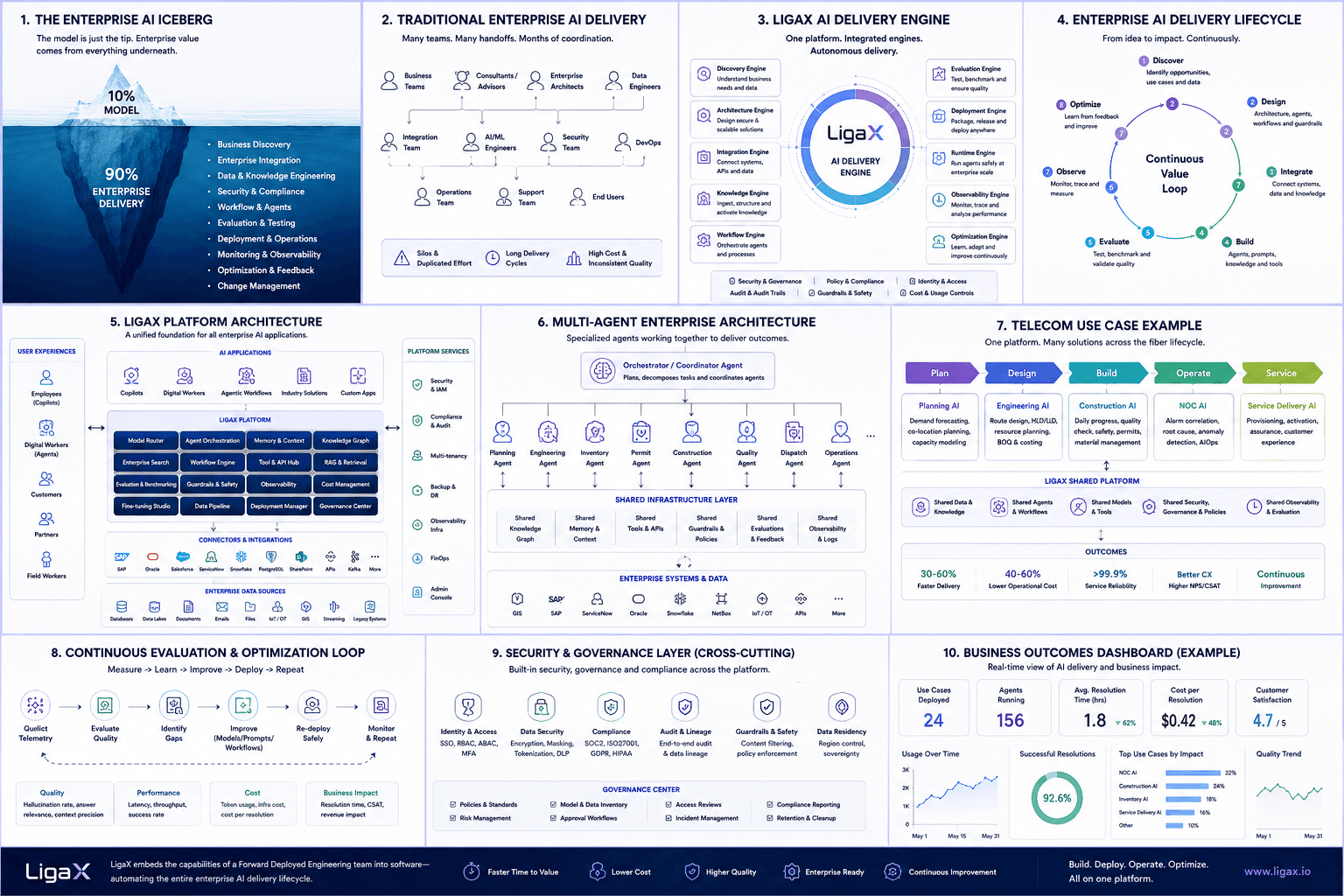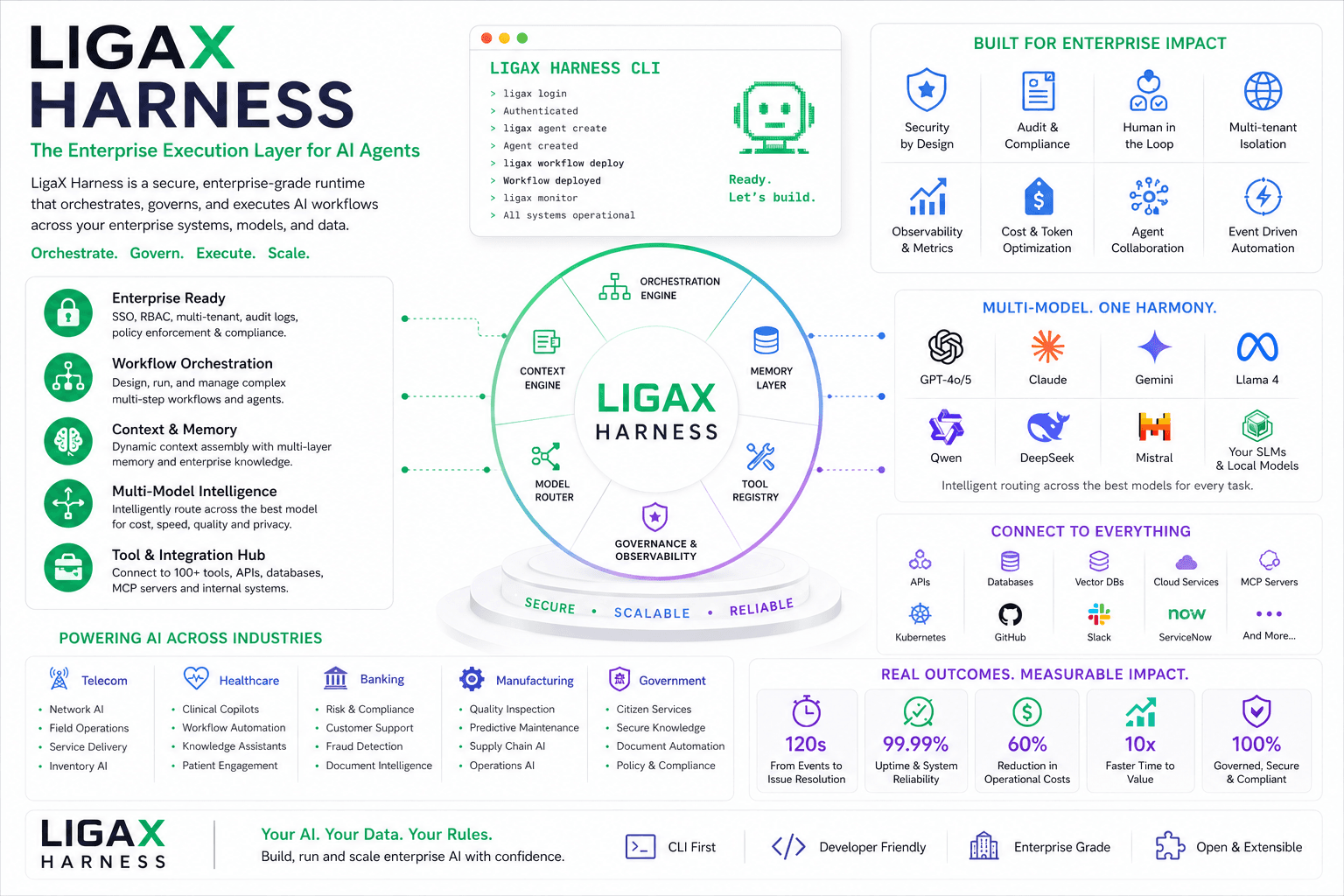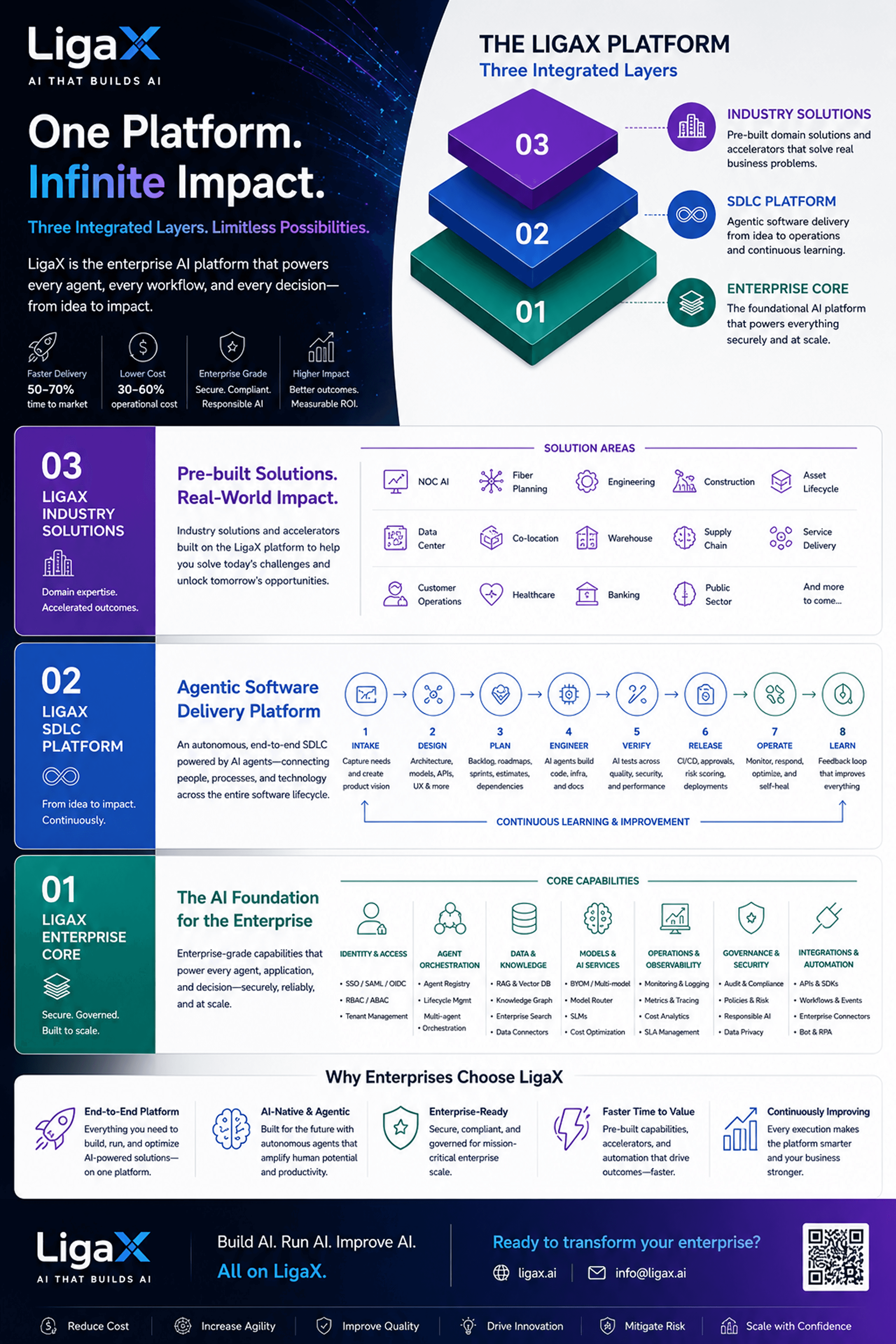

Plan, implement, and run ServiceNow on an AI-native harness.
More than 25 purpose-built AI Specialists carry a requirement from a ready story through implementation to shipped configuration — reasoning, calling tools, and checking results inside firm guardrails.
| 25+ | Plan | Build | Run | Minutes |
|---|---|---|---|---|
| AI Specialists | Stories & Design | Scripts · Flows · Config | AI Agents · Automation | Not weeks |
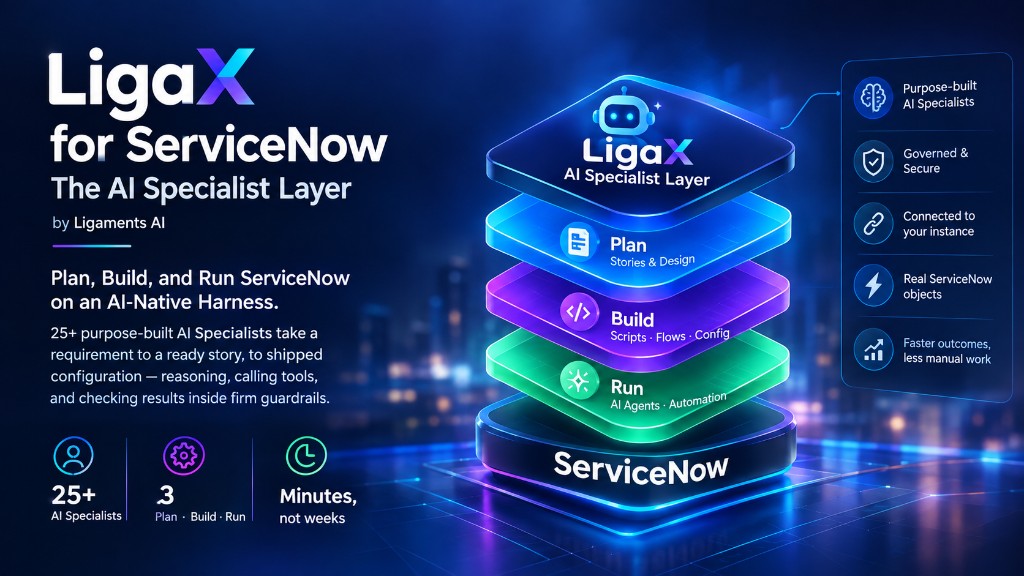 LigaX for ServiceNow — the AI Specialist Layer sitting on Plan, Build, Run, and ServiceNow
The specialist layer sits above ServiceNow. It does not replace the platform. It drafts stories, implements real objects, and runs agents against your instance — governed, connected, and measurable.
Why We Built This
 Why We Built This
ServiceNow teams lose days turning requirements into complete, well-formed stories — and then more days implementing them by hand. Acceptance criteria get written field by field. Formatting shifts from person to person. And every handoff between a requirement, the story, and the instance is time the sprint never recovers.
That is not a talent problem. It is a tooling gap.
- Slow story writing and implementation — hours per epic spent drafting acceptance criteria, then building the same work again in ServiceNow.
- Inconsistent output — structure, fields, and the objects they become change from analyst to analyst, and from module to module.
- Delayed delivery — each manual handoff between the requirement, the build, and ServiceNow adds cycle time.
- Fragmented tooling — CMDB, ITAM, Incident, and Change each depend on their own institutional know-how.
What LigaX Does — One Platform, Three Jobs
 What LigaX Does — One Platform, Three Jobs
Most tools stop at the draft. LigaX plans the work, implements it on ServiceNow, and runs it through to completion.
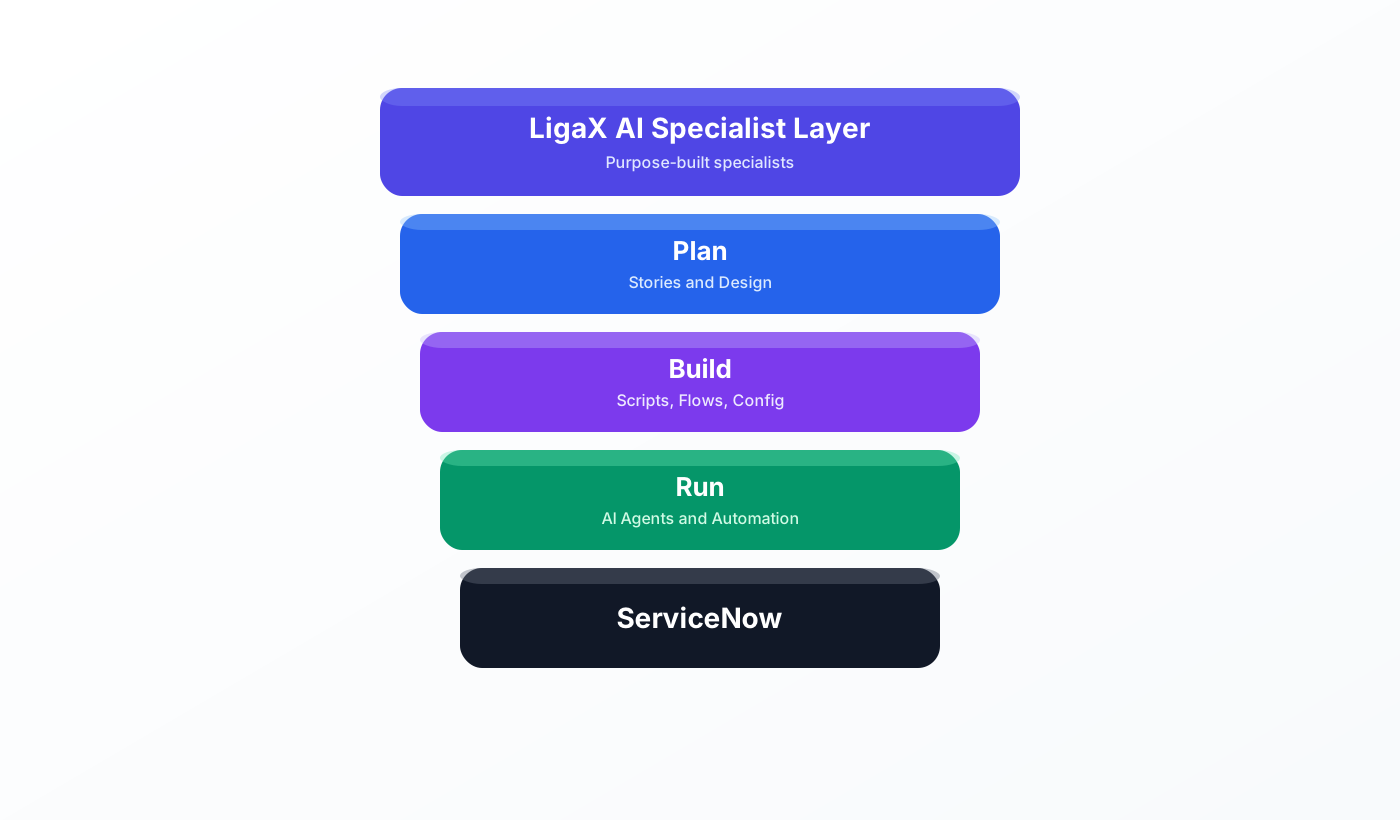 LigaX AI Specialist Layer over Plan, Build, Run, and ServiceNow
- Plan — Story generation. Turn a requirement, SOW, or guided Q&A into approval-ready stories: structured fields, acceptance criteria, epics, and themes — ready for the same specialist to implement.
- Build — Implementation. Generate scripts, flows, catalog items, and integrations as real ServiceNow objects, then push them through tracked update sets.
- Run — AI Agents. Autonomous agents dispatch, provision, reconcile, and coordinate work inside the instance, under human approval.
The Philosophy
 The Philosophy
Most backlog tools ask one question: how do I write this story faster?
LigaX asks another — and implements the answer.
How does an enterprise turn intent into governed, working ServiceNow — story, script, flow, and config — reliably, at scale, across every practice it runs?
The answer is not a better text editor. It is a specialist layer that already knows the shape of sound Incident routing, a solid CMDB relationship, or a compliant Change record — and how to implement each one as a real ServiceNow artifact.
Three Ways to Build — and Implement
 Three Ways to Build — and Implement
One specialist. Three ways in. Each path drafts the work and can implement it on ServiceNow — stories, then scripts, flows, and configuration, on approval.
- Starter Stories — ready-made backlog packs per module (Default, Development, Plugins). More than 30 stories per pack. Select, review, implement, and push.
- Configuration — choose a focus area (routing, SLAs, escalation, lifecycle) and answer a guided Q&A that becomes approval-ready stories and shipped configuration.
- Custom Requirement — describe the need in plain language; the specialist asks follow-ups, drafts with you, implements the build, and ships on approval.
Idea to Instance — The Five-Step Pipeline
 Idea to Instance — The Five-Step Pipeline
Whichever path you take, intent is drafted, implemented, and pushed to a live instance through one governed pipeline.
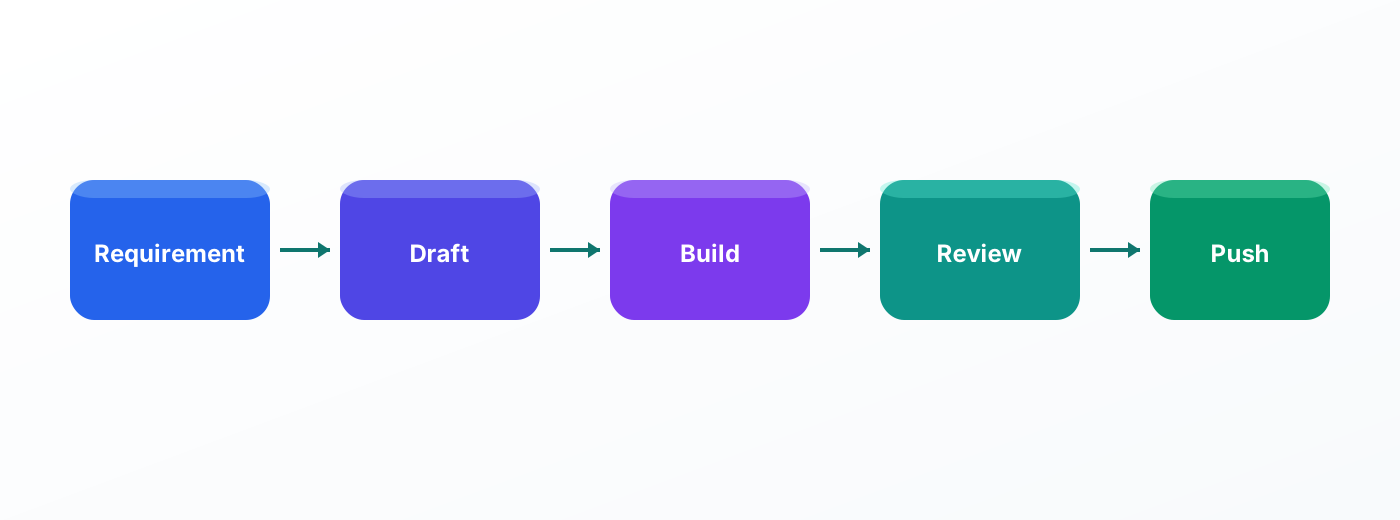 Requirement, Draft, Build, Review, Push pipeline
- Requirement — plain language, a SOW, or a guided Q&A.
- Draft — the specialist writes structured stories ready for implementation.
- Build — scripts, flows, and configuration are implemented as real ServiceNow objects.
- Review — you inspect and approve every change.
- Push — the implementation goes through a tracked update set.
A Specialist for Every Practice
 A Specialist for Every Practice
These specialists are domain-trained, not generalist. Each one owns a ServiceNow practice from end to end — story through implementation — active and ready today.
| Service delivery | Assets and inventory | Governance | Orders and telecom |
|---|---|---|---|
| Incident | CMDB | Governance | OMT |
| Problem | CMDB Health | Compliance | Sales and Order Management |
| Change | Hardware Assets | Risk | Salesforce to ServiceNow |
| Major Incident | Software Assets | Release | Metasolv to ServiceNow |
| Case | Network Assets | ||
| Service Catalog | Network Inventory | ||
| Service Portfolio | |||
| Knowledge |
Incident · Problem · Change · Major Incident · Case · OMT · Governance · Compliance · Risk · CMDB · CMDB Health · Hardware Assets · Software Assets · Network Assets · Release · Knowledge.
The catalog also includes Service Catalog, Service Portfolio, Sales & Order Management, Salesforce ↔ ServiceNow, Metasolv → ServiceNow Migration, Network Inventory — plus dedicated AI Agents.
Domain Deep Dives
 Domain Deep Dives
Each specialist drafts the work and implements it in that domain.
- Assets — CMDB and Health (CIs, relationships, accuracy dashboard); Hardware and Software Assets (lifecycle, licenses, compliance); Network Assets and Inventory.
- Service delivery — Case Management; Service Catalog; Service Portfolio.
- OMT — Order Management for Telecommunications: models and implements telecom products, orders, and fulfillment from end to end.
- Governance, Compliance & Risk — policies, ownership, and accountability; controls mapped to regulations with audit-ready evidence; risks identified, scored, and tracked, with treatments tied to controls.
- Sales, orders & fulfillment — Sales & Order Management; Salesforce ↔ ServiceNow integration; Metasolv → ServiceNow Migration.
- Knowledge — implement and govern Knowledge Bases, categories, templates, and user criteria from a guided conversation.
The AI Harness
 The AI Harness
LigaX runs a real harness — the control system that lets a model think, call tools, check results, and keep going until the work is implemented, inside firm boundaries with managed memory. Every Specialist and Agent runs on it.
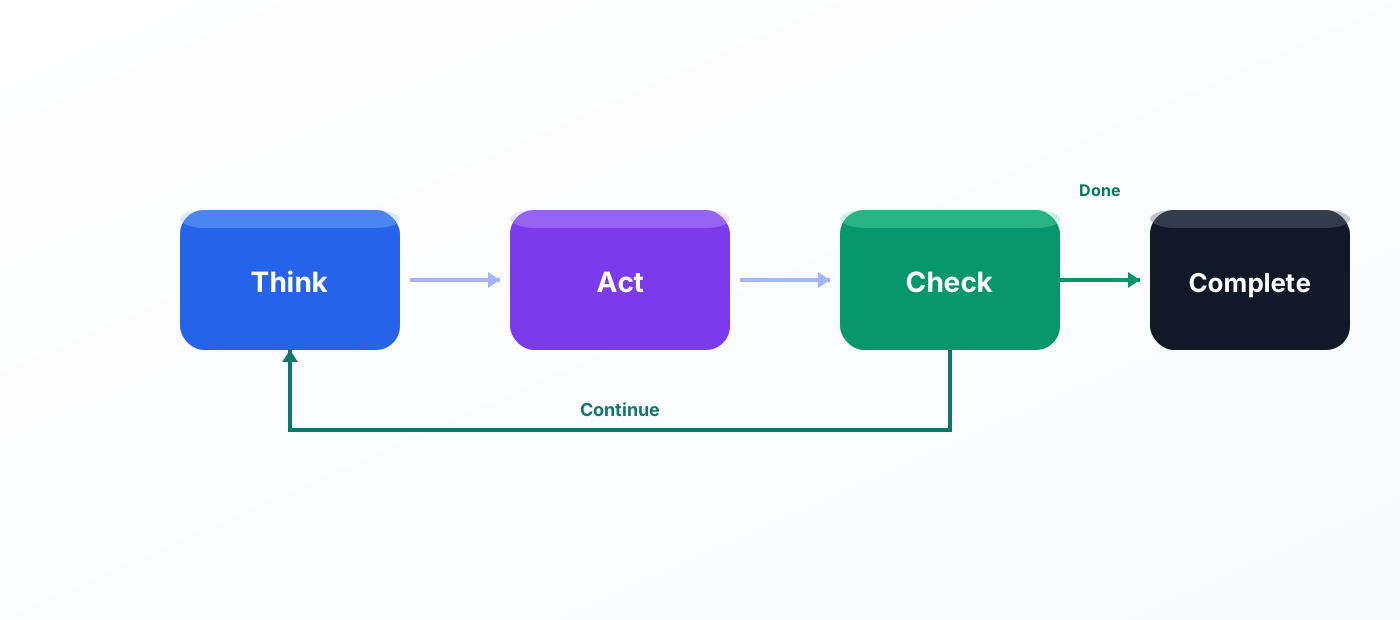 Think, Act, Check loop with Continue and Complete
- Execution Loop — reason, act, read, decide; iterate on its own until the work is done or a boundary stops it.
- Tool Integration — real tools: APIs, files, CLIs, and ServiceNow through Table API, GlideRecord, and update sets — schema-typed.
- Sandboxing & Guardrails — isolated execution; scope, RBAC, and the human write-gate enforced by the platform, not by a prompt.
- Context & Memory Management — the right prompts, rules, and logs retrieved and compacted to fit, plus persistent project memory.
What owning the harness gives you
- Autonomous multi-step runs with a step budget and stop conditions
- Precision by design through schema-typed, validated calls
- Safety by construction through sandbox, RBAC, and a write-gate
- Persistent memory so nothing has to be learned twice
- Soft failure — caught, retried, contained
- Model-agnostic routing so cost and reasoning tiers can be swapped
Observability & Trace
 Observability & Trace
The harness instruments itself. Security, latency, cost, and success feed one layer; every span can be opened and replayed.
| Signal | Illustrative reading |
|---|---|
| Tool-call success | 99.4% rolling, across all specialists |
| Median latency | 1.4s per specialist action |
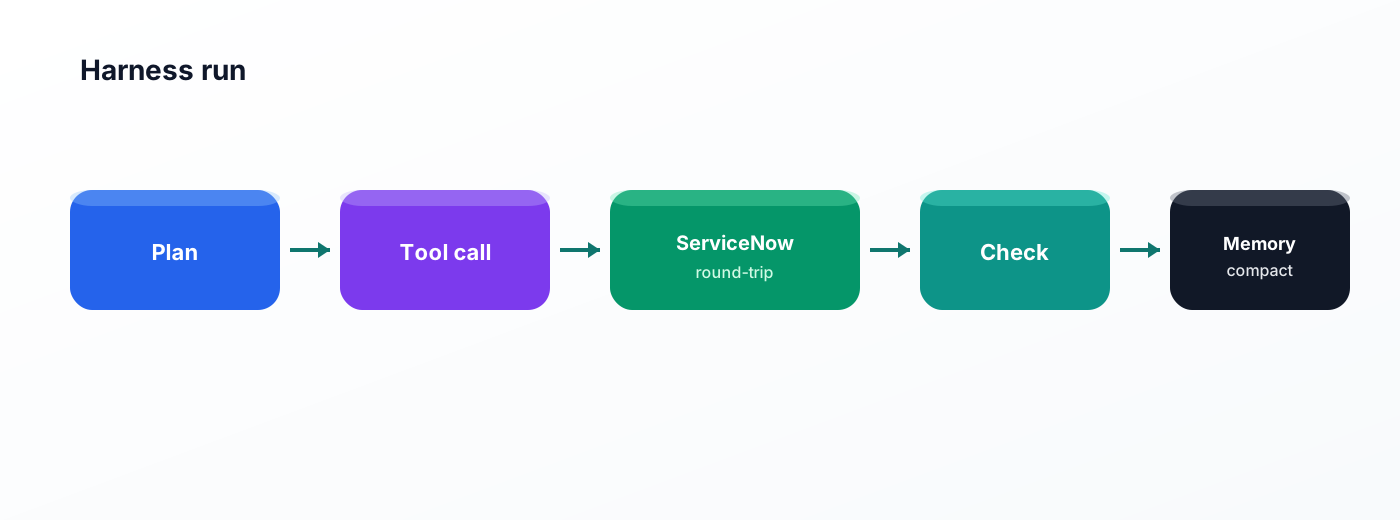 Harness run trace from Plan to Memory compact
A full harness run — including implementation calls — traces as timed, color-coded spans by component. ServiceNow round-trips take most of the time; everything else stays in milliseconds.
Measurable Impact
 Measurable Impact
Once drafting and implementation are no longer manual, the cycle shortens.
| Dimension | Before | With LigaX |
|---|---|---|
| Story drafting | Manual, per analyst | Guided or automatic, per specialist |
| Implementation | Manual scripts and flows | Specialist-generated objects, reviewed and pushed |
| Format consistency | Varies by author | Standardized fields every time |
| Time to backlog | Days of grooming | Minutes of review |
| ServiceNow handoff | Manual copy-paste | Direct push via update set |
| Audit trail | Scattered across tools | Logged automatically per action |
Illustrative; actuals depend on team, module, and workload.
Security & Trust
 Security & Trust
Governed, gated, and auditable — enforced on every route, logged on every action, including every implementation write.
- Azure AD SSO + RBAC — SSO or credentials, with roles enforced on every API route.
- Argon2 · role-based JWT — memory-hard hashing; roles carried in the session token.
- Env-gated integrations — ServiceNow OAuth and credentials never reach the client.
- Full audit trail — every tool call logged: user, scope, outcome, update set.
It runs serverless and autoscaling on managed PostgreSQL, with health probes.
Live in Four Steps
 Live in Four Steps
Most teams produce stories — and can implement them — in their first session.
- Connect — link Azure AD and your ServiceNow instance.
- Activate — turn on the specialists you need first.
- Generate — run starter packs, configuration, or custom requirements through to implementation.
- Go live — push approved implementation into ServiceNow.
The Stack in One View
Purpose-built AI Specialists. Governed and secure. Connected to your instance. Real ServiceNow objects, drafted and implemented. Faster outcomes, and less manual work.
Conclusion
 Conclusion
Give your ServiceNow an AI specialist of its own, that can plan, implement, and run on a harness engineered for safety by design and end-to-end observability.