

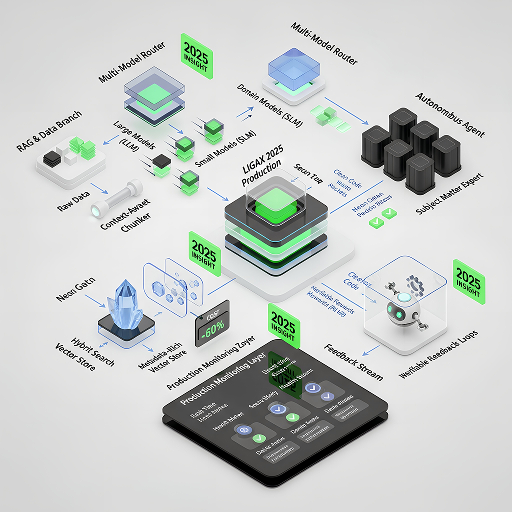
As we close out 2025, it's worth reflecting on the key lessons learned from deploying enterprise AI at scale. This year tested our assumptions and shaped our platform in fundamental ways.
1. The RAG Reality Check
 1. The RAG Reality Check
What We Learned: Production RAG is 80% data engineering, 20% AI. The challenges:
-
Chunking is an art, not a science: Fixed-size chunks destroy semantic coherence in technical documents. We developed context-aware chunking that respects document structure, entity boundaries, and relationship hierarchies.
-
Metadata matters more than we expected: Retrieval quality depends heavily on rich metadata (source, date, author, confidence, relationships). Our systems now treat metadata as a first-class citizen.
-
Hybrid search is non-negotiable: Pure semantic search misses exact matches; pure keyword search misses semantic variations. We consistently see 30-40% improvement with hybrid approaches.
-
Evaluation is the hardest problem: Standard metrics (ROUGE, BLEU) don't correlate with user satisfaction. We now use task-specific evaluation datasets with human-labeled ground truth.
Key Win: Our RAG system processing 6,000+ documents with complex entity relationships validated our approach to hierarchical chunking and multi-dimensional retrieval.
2. The Multi-Model Imperative
 2. The Multi-Model Imperative
What We Learned: Different tasks demand different models, and the "best" model changes monthly:
-
Task-specific optimization: GPT-4 for complex reasoning, Claude for long documents, Gemini Flash for high-throughput classification
-
Cost vs. quality trade-offs: In production, a $0.0001 per request difference matters at scale. We built dynamic routing that balances cost and quality based on request characteristics.
-
Latency constraints drive decisions: Real-time applications can't wait 10 seconds for GPT-4. We developed latency-aware model selection.
-
Open-source viability: Llama 3 and Mistral reached production quality for many tasks, with 10-100x cost savings.
Key Win: Our model recommendation engine saved clients 40-60% on inference costs while maintaining quality thresholds.
3. Agentic Systems: Promise and Peril
 3. Agentic Systems: Promise and Peril
What We Learned: Autonomy requires sophisticated guardrails and human-in-the-loop design:
-
Tool reliability is paramount: Agents are only as good as their tools. We invested heavily in robust, well-documented function calling.
-
Observability is critical: When agents make decisions autonomously, you need comprehensive logging of reasoning chains, tool calls, and decision points.
-
Failure modes are complex: Agents don't just fail—they fail creatively in ways you didn't anticipate. We now use extensive simulation testing.
-
Human oversight isn't optional: True autonomy works for low-stakes tasks. High-stakes decisions need human confirmation workflows.
Key Win: Our network fault detection agents reduced MTTR by 60% while maintaining human oversight for critical infrastructure changes.
4. The Data Quality Bottleneck
 4. The Data Quality Bottleneck
What We Learned: Data quality is multidimensional and context-dependent:
-
Completeness ≠ Quality: Complete records with outdated information are worse than incomplete recent records.
-
Consistency is relative: Different systems define the same entity differently. Entity resolution became our most complex engineering challenge.
-
Temporal dynamics matter: Data quality degrades over time. We now build freshness tracking and automatic deprecation.
-
Quality scoring is essential: Every data point needs a confidence score based on source reliability, recency, and validation status.
Key Win: Our ServiceNow migrations achieved 99.9% data accuracy through multi-stage validation and reconciliation pipelines.
5. The Production Gap
 5. The Production Gap
What We Learned: Production is a different beast entirely:
-
Scale changes everything: Patterns that work for 100 documents fail at 10,000. We now performance-test at 10x expected scale.
-
Error handling is 50% of the code: Graceful degradation, retry logic, circuit breakers, and fallback strategies are essential.
-
Monitoring is not optional: We instrument everything—latency, token usage, error rates, user satisfaction, cost per transaction.
-
Security cannot be bolted on: RBAC, encryption, audit logging, PII detection must be architected from day one.
Key Win: Zero production incidents across major deployments in Q4 2025, thanks to comprehensive testing and monitoring.
6. The Human Factor
 6. The Human Factor
What We Learned: AI augments human expertise rather than replacing it:
-
Domain expertise remains critical: AI can process information, but domain experts provide context and judgment.
-
Change management matters: The best technical solution fails without user adoption. We now include training and change management in every deployment.
-
Feedback loops drive improvement: Active user feedback—not just passive metrics—leads to the highest-quality systems.
Key Win: Projects with embedded subject matter experts from day one showed 3x higher user satisfaction and adoption rates.
7. The Small Language Model Revolution
 7. The Small Language Model Revolution
What We Learned: Domain-specific fine-tuned SLMs often outperform large general models:
-
Task specialization beats generalization: A fine-tuned 8B parameter model trained on telecom fault diagnosis outperformed GPT-4 for that specific task.
-
Economics drive adoption: 100x cost savings make previously uneconomical use cases viable (processing millions of tickets, real-time classification).
-
Latency matters more than we expected: 150ms vs. 3000ms response time transforms user experience.
-
Data efficiency surprises: High-quality domain-specific datasets of 5,000-10,000 examples produced models that rival general models trained on trillions of tokens.
-
RLHF is transformative: Reinforcement learning from domain expert feedback created models that aligned with nuanced business rules and preferences.
-
On-premise deployment is non-negotiable: For regulated industries, the ability to deploy models behind the firewall outweighed raw performance differences.
Key Win: Deployed 12 domain-specific models across healthcare, telecom, manufacturing, and banking with average 85% cost reduction and 15-20% accuracy improvement over general models for specific tasks.
8. RLVR: The Next Frontier in Model Training
 8. RLVR: The Next Frontier in Model Training
What We're Learning: Reinforcement Learning with Verifiable Rewards (RLVR) shows promise for tasks with objective correctness:
- Code generation: Verifiable through test execution
- Structured output: Validatable against schemas
- Mathematical reasoning: Checkable solutions
- Data transformation: Exact match requirements
Early experiments show:
- Faster convergence compared to human feedback loops
- More consistent outcomes without human evaluator variance
- Scalable evaluation for millions of training examples
- Clearer optimization targets for reward modeling
Challenge: RLVR requires well-defined verification functions—not all enterprise tasks have clear correctness criteria.
Key Win: RLVR-trained models for network configuration generation achieved 97% first-attempt success rate, up from 82% with RLHF alone.